Electronics manufacturing now runs under constant pressure in component shortages that disrupt sourcing procurement, multi-level BOMs demand strict control, and tight tolerances leave no room for error. Product cycles move fast, pushing teams to manage frequent design changes, supplier shifts, and inventory fluctuations without slowing production. In this environment, even small inefficiencies across electronic manufacturing can translate into missed deadlines and rising operational costs.
Basic tools fail to keep pace with this level of complexity. Electronics manufacturing requires a connected approach where sourcing procurement, production planning, and a manufacturing inventory management system operate in sync. Without that alignment, businesses face data gaps, delayed decisions, and reduced visibility across the supply chain.
This is where Odoo manufacturing, backed by a robust Odoo ERP system, enters the conversation. Electronics businesses are turning to Odoo ERP software to gain tighter control over inventory, streamline sourcing procurement, and manage intricate BOM structures within a single ecosystem. The shift is driven by the need for accuracy, traceability, and operational clarity across electronic manufacturing workflows.
This blog post breaks down how Odoo manufacturing supports electronics manufacturing at scale. It explores key capabilities within the Odoo ERP system, compares its position against traditional solutions, and helps you assess whether Odoo ERP software aligns with your manufacturing inventory management system requirements and long-term growth plans.
What Is Odoo ERP for Manufacturing and How Does It Help Electronics Companies?
Odoo ERP software is an open-source business platform designed to manage end-to-end operations across electronics manufacturing. With Odoo manufacturing at its center, the system connects inventory, sourcing, procurement, accounting, CRM, and production into one connected environment. For electronics companies dealing with complex assemblies and fast-moving demand, this level of integration supports tighter control, faster execution, and stronger cost visibility.
The Odoo ERP system links production planning, sourcing procurement, manufacturing inventory management system functions, quality checks, and financial tracking without fragmentation. Teams work with shared data across departments, reducing dependency on disconnected tools and minimizing delays caused by information gaps. In electronics manufacturing, where timing and accuracy shape profitability, this connection drives measurable improvements in throughput and delivery performance.
Key Challenges in Electronics Manufacturing That Odoo ERP Solves
Electronics manufacturing presents unique operational demands. Odoo ERP software addresses these challenges with capabilities aligned to the realities of electronic manufacturing:
- Multi-level BOM Management
Complex assemblies with nested components require tight version control. Odoo manufacturing manages multi-level bills of materials with accuracy, enabling teams to handle intricate product structures without confusion.
- Component Traceability
Tracking parts by serial and lot number is critical in electronic manufacturing. The Odoo ERP system ensures traceability across the lifecycle from sourcing procurement to production and shipment by supporting compliance and faster issue resolution.
- Short Product Lifecycles & Engineering Changes
Frequent design updates can disrupt production. Odoo manufacturing allows teams to manage revisions, update BOMs, and align inventory without halting operations.
- Supplier and Contract Manufacturer Coordination
Electronics companies depend on distributed sourcing procurement networks. Odoo ERP software connects internal teams with external suppliers and contract manufacturers, improving visibility and coordination across the supply chain.
- Streamlined Workflows Across Departments
Disconnected handoffs between departments slow down electronics manufacturing. The Odoo ERP system eliminates these bottlenecks by aligning sourcing procurement, production, inventory, and finance within one platform. This reduces delays, improves accountability, and keeps production cycles moving without friction.
Real-World Workflow Example
Consider an electronics assembly business using Odoo manufacturing:
A sales order enters the Odoo ERP system, triggering demand within the manufacturing inventory management system. The platform checks component availability and initiates sourcing procurement for any shortages. Once materials arrive, production orders are generated based on the defined BOM structure.
During assembly, the system tracks components through serial or lot numbers, ensuring full traceability. Quality checks are recorded within the workflow, and finished goods are updated in inventory. Finally, the order moves to packaging and shipment, with financial entries recorded in Odoo ERP software without duplicate data entry. This connected flow across electronic manufacturing operations allows businesses to move from order to delivery with speed, accuracy, and complete visibility turning operational complexity into a controlled, scalable process.
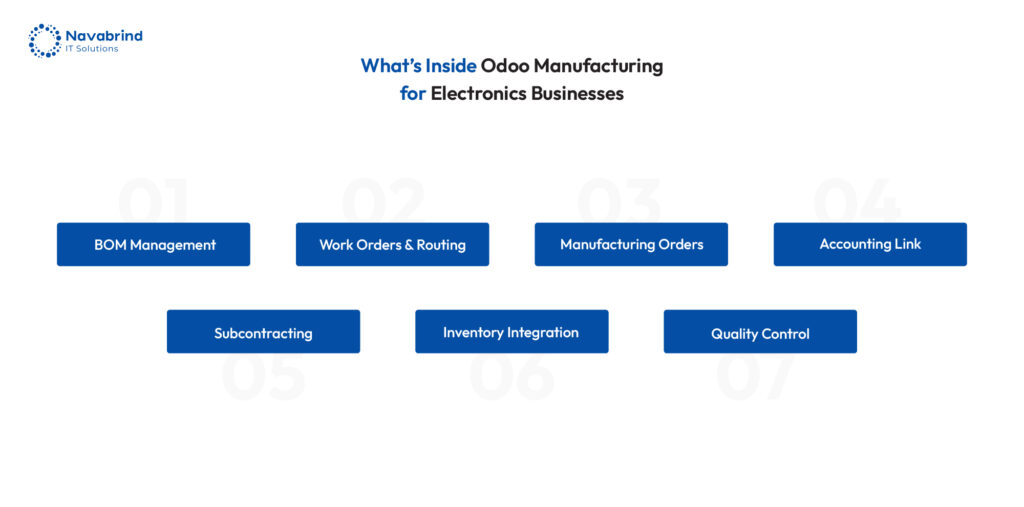
What Does the Odoo Manufacturing Module Include?
Odoo manufacturing brings structure and control to electronics manufacturing by aligning production, sourcing procurement, and the manufacturing inventory management system within one environment. The module supports complex electronic manufacturing operations without forcing teams to rely on disconnected tools.
Bill of Materials (BOM) Management
Odoo ERP software handles multi-level BOMs with configurable and variant-based structures. Electronics manufacturing teams can manage intricate assemblies, alternate components, and version updates without confusion. This is critical when dealing with frequent design changes and component substitutions driven by sourcing procurement constraints.
The Odoo ERP system defines production steps, assigns workcenters, and tracks execution time across operations. For electronic manufacturing, where precision in sequencing impacts output quality, this ensures each stage follows a controlled path with full visibility into performance.
Production runs are created, planned, and monitored within Odoo manufacturing. The system aligns demand from sales with available inventory and sourcing procurement inputs, helping electronics manufacturing teams maintain production continuity without overproduction or delays.
Electronics businesses that rely on external vendors benefit from integrated subcontracting management. Odoo ERP software tracks outsourced assembly, component processing, and vendor timelines, ensuring sourcing procurement and production stay aligned across partners.
Managing multiple SKUs, such as variations in voltage, form factors, or configurations becomes structured within the Odoo ERP system. Electronics manufacturing teams can handle product diversity without losing control over BOM accuracy or inventory tracking.
Odoo manufacturing supports make-to-order and make-to-stock strategies within the manufacturing inventory management system. This flexibility helps electronics companies respond to demand shifts while maintaining optimal stock levels and avoiding excess inventory.
Scrap and Rework Management
Waste and defective units are tracked within production workflows. Odoo ERP software allows electronics manufacturing teams to manage scrap, initiate rework processes, and maintain accountability across operations key for cost control and quality improvement.
The Odoo ERP system provides live insights into workcenter loads, order progress, and production constraints. Electronics manufacturing leaders gain visibility into bottlenecks and can take corrective action before delays impact delivery timelines.
Integration Across Business Functions
Odoo manufacturing connects with inventory, sourcing procurement, quality checks, and accounting within the Odoo ERP system. This integration ensures that data flows across electronic manufacturing operations without duplication, supporting faster decisions and tighter operational control.
By combining these capabilities, Odoo ERP software transforms how electronics manufacturing businesses manage complexity bringing consistency, traceability, and control across the manufacturing inventory management system.
How Does Inventory Management Software for Manufacturing Improve Electronics Production?
Inventory defines success or failure in electronics manufacturing. Component delays disrupt sourcing procurement, price shifts compress margins, and outdated parts drain capital. One unavailable component can stop production instantly, making inventory control a critical factor in maintaining output and profitability.
A manufacturing inventory management system within Odoo ERP software brings order to this complexity. The Odoo ERP system connects inventory with sourcing procurement, production schedules, and sales demand, creating a synchronized flow of materials across electronic manufacturing operations. This alignment ensures the availability of components without tying up capital in excess stock.
Key Inventory Capabilities in Odoo for Electronics Manufacturing:
Multi-Warehouse and Multi-Location Management
Electronics manufacturing environments operate across multiple warehouses and storage zones. Odoo manufacturing tracks inventory movement across locations, giving teams full control over stock distribution and availability.
Serial and Lot Tracking
Traceability remains essential in electronic manufacturing. The Odoo ERP system records component and finished goods movement through serial and lot tracking, enabling fast response to defects, compliance checks, and product recalls.
Replenishment and Safety Stock Management
Odoo ERP software maintains stock levels through demand-driven replenishment rules. Sourcing procurement teams can prevent shortages while avoiding excess inventory, maintaining balance across the manufacturing inventory management system.
Landed Cost Visibility
Imported components involve layered costs such as freight, duties, and handling. The Odoo ERP system captures these values, giving electronics manufacturing businesses accurate cost structures and better pricing decisions.
Barcode-Enabled Warehouse Operations
Warehouse execution improves with barcode scanning. Teams handle receiving, picking, and dispatch with speed and accuracy, reducing errors across the manufacturing inventory management system.
Demand Forecasting Connected to Production
Odoo manufacturing links sales demand with production planning and inventory levels. Electronics manufacturing teams gain foresight into material requirements, allowing sourcing procurement to prepare without delays.
Learn more : Can Odoo Manufacturing handle multi-level Bills of Materials
Impact on Production and Cost Control
Accurate inventory within the Odoo ERP system eliminates production interruptions caused by missing components. At the same time, electronics manufacturing businesses reduce excess stock, releasing working capital for growth and operational investment. This balance strengthens cost control and production stability.
Inventory and On-Time Delivery Performance
Delivery timelines depend on material readiness. When sourcing procurement, inventory, and production operate in sync through Odoo ERP software, electronics manufacturing companies maintain consistent output and meet delivery commitments without disruption. This reliability strengthens customer confidence and drives repeat business across electronic manufacturing operations.
Why Should Electronics Manufacturers Choose Odoo Manufacturing ERP Over Other Solutions?
Electronics manufacturing demands speed, accuracy, and control across sourcing procurement, production, and inventory. Generic ERP platforms struggle in this environment. Enterprise-grade systems such as SAP, Oracle, and Microsoft Dynamics come with complexity designed for large-scale enterprises, leaving mid-sized electronics manufacturing firms dealing with long deployment cycles and heavy operational overhead. On the other side, point solutions create fragmentation. Production, sourcing procurement, finance, and the manufacturing inventory management system operate in isolation, leading to data inconsistencies, delayed decisions, and limited visibility across electronic manufacturing workflows.
What Odoo Manufacturing Does Differently:
Odoo manufacturing, within the Odoo ERP system, takes a connected and scalable approach tailored for electronics manufacturing businesses that need control without unnecessary complexity.
Modular Adoption That Matches Growth
Electronics manufacturing companies can begin with manufacturing and the manufacturing inventory management system, then expand into sourcing procurement, accounting, and CRM as operations evolve. This phased approach avoids unnecessary upfront investment while supporting growth.
Unified Data Model Across Operations
The Odoo ERP system connects sourcing procurement, production, inventory, and finance within one data structure. This removes the need for external integrations and ensures consistent information flow across electronic manufacturing processes.
Lower Total Cost of Ownership
Compared to traditional enterprise systems, Odoo ERP software reduces licensing, deployment, and maintenance costs. Electronics manufacturing firms gain enterprise-level capabilities without the financial burden associated with large-scale ERP platforms.
Faster Implementation for Mid-Sized Manufacturers
Electronics businesses can deploy Odoo manufacturing in a shorter timeframe, allowing teams to transition from disconnected systems to a fully operational Odoo ERP system without prolonged disruption.
Continuous Product Evolution
Odoo ERP software introduces annual updates, bringing enhancements aligned with manufacturing and sourcing procurement needs. Electronics manufacturing companies benefit from ongoing improvements without requiring major system overhauls.
Strong Ecosystem and Partner Network
A global network of certified partners and developers supports the Odoo ERP system. Electronics manufacturing firms can extend functionality, customize workflows, and integrate additional tools to match their operational model.
Where Odoo ERP Stands Out for Electronics Manufacturing:
For electronics manufacturing companies operating below enterprise scale, Odoo manufacturing delivers flexibility, ease of use, and faster return on investment. The platform aligns sourcing procurement, production, and the manufacturing inventory management system in a way that supports growth without adding operational friction.
This balance makes Odoo ERP software a practical choice for electronic manufacturing businesses aiming to scale operations, improve control, and maintain profitability in a competitive market.
Is Manufacturing Inventory Software Like Odoo Suitable for Small Electronics Manufacturers?
A common belief suggests ERP systems only suit large-scale operations. In electronics manufacturing, that assumption leads to missed opportunities. Smaller firms face the same challenges as larger players, component shortages, sourcing procurement pressure, and the need for accurate inventory control yet operate with lean teams and tighter budgets.
- BOM Management Without IT Burden
Odoo manufacturing enables structured bill of materials management for electronics manufacturing, allowing teams to handle multi-level assemblies without technical overhead.
- Component Tracking Without Dedicated Warehouse Teams
The manufacturing inventory management system within the Odoo ERP system tracks components through serial and lot numbers, supporting traceability even with limited staff.
- Production Scheduling and Order Visibility
Odoo ERP software provides clear production planning and order tracking, helping small electronics manufacturing teams stay aligned with demand and delivery timelines.
- Integrated Accounting
Financial data flows alongside sourcing procurement, inventory, and production within the Odoo ERP system, removing duplicate data entry and reducing errors.
How Odoo Scales for Smaller Operations:
Odoo manufacturing supports a phased approach. Small electronics manufacturing companies can begin with two or three modules, such as manufacturing, inventory, and accounting then expand into sourcing procurement, CRM, or quality management as operations grow. This approach allows businesses to adopt the Odoo ERP system without unnecessary upfront investment.
Odoo Community vs. Odoo Enterprise
The Odoo ERP system is available in two editions:
- Community Edition
A free, open-source version suited for small electronics manufacturing firms with basic requirements and access to technical resources for setup and customization.
- Enterprise Edition
A paid version of Odoo ERP software that includes additional features, user interface enhancements, and support services. Electronics manufacturing companies seeking extended functionality and support often prefer this option.
Cost Considerations for Small Electronics Manufacturers
For smaller operations, cost remains a deciding factor. Odoo ERP software offers flexibility in licensing and deployment. Expenses typically include implementation, configuration, and ongoing support. Compared to traditional ERP systems, the overall investment remains manageable, especially when aligned with phased adoption.
Where Odoo Fits and Where Extensions May Help
Odoo manufacturing fits well for small electronics manufacturing businesses that need control over sourcing procurement, production, and the manufacturing inventory management system without excessive complexity. In cases involving niche requirements such as specialized compliance tracking or advanced production constraints third-party modules within the Odoo ERP system ecosystem can extend functionality to match operational needs. For small electronic manufacturing firms aiming to improve visibility, reduce errors, and build a scalable foundation, Odoo ERP software offers a practical path forward without overwhelming internal teams.
What Makes Odoo ERP Manufacturing Different in 2026?
Odoo ERP software has evolved from a small business tool into a serious contender for mid-sized electronics manufacturing companies. The Odoo ERP system now supports complex electronic manufacturing environments with stronger production control, tighter sourcing procurement alignment, and a more capable manufacturing inventory management system.
Key Advancements for Electronics Manufacturing:
Enhanced Subcontracting Workflows
Contract-based electronic manufacturing relies on external partners for assembly and component processing. The Odoo ERP system improves coordination with subcontractors, ensuring sourcing procurement, material supply, and production timelines remain aligned.
Improved MRP with Supply Chain Visibility
Material Requirements Planning within Odoo ERP software now provides stronger visibility into component availability, lead times, and dependencies. Electronics manufacturing businesses can plan production with greater confidence, even in volatile sourcing procurement conditions.
Integrated Quality Control Within Production
Quality checks are embedded into Odoo manufacturing workflows, allowing electronics manufacturing teams to monitor product standards during production rather than after completion. This reduces defects and strengthens compliance across electronic manufacturing operations.
Mobile-First Warehouse and Shop Floor Operations
The Odoo ERP system supports mobile-enabled workflows across warehouses and production floors. Teams managing the manufacturing inventory management system can track materials, update production status, and manage sourcing procurement activities without being tied to desktops.
Cloud-First Deployment and Operational Flexibility
Odoo ERP software now emphasizes cloud-based deployment. For electronics manufacturing companies, this enables remote access to sourcing procurement data, production schedules, and inventory insights. Updates roll out without disruption, and data security standards remain aligned with global requirements.
Sustainability and Compliance in Manufacturing
Electronics manufacturing faces increasing pressure around environmental compliance and traceability. The Odoo ERP system incorporates reporting capabilities that track material usage, waste, and regulatory requirements within manufacturing workflows. This supports responsible production without adding external systems.
Open Architecture for Electronics Ecosystems
The flexibility of Odoo manufacturing allows integration with tools used across electronic manufacturing, including CAD and PLM systems, testing equipment, and specialized extensions. This ensures that electronics manufacturing businesses can maintain their technical workflows while centralizing operations within the Odoo ERP system.
Why 2026 Is the Right Time to Evaluate Odoo
The maturity of Odoo ERP software, combined with competitive pricing, positions it as a strong option for electronics manufacturing companies seeking control over sourcing procurement, production, and the manufacturing inventory management system.
For businesses aiming to scale without the burden of complex enterprise systems, the Odoo ERP system delivers a balanced approach capable enough to handle electronic manufacturing demands while remaining accessible for growing operations.
What to Expect When Implementing Odoo ERP in an Electronics Manufacturing Business
Implementing Odoo ERP software in electronics manufacturing requires planning, disciplined data preparation, and alignment across sourcing procurement, production, and the manufacturing inventory management system. When executed with clarity, the Odoo ERP system becomes the operational backbone for electronic manufacturing connecting workflows from demand to delivery.
Typical Implementation Phases
Requirements Mapping
Define how electronics manufacturing workflows operate today—covering BOM structures, sourcing procurement flows, inventory handling, and production cycles. This stage sets the foundation for configuring Odoo manufacturing in line with business needs.
System Configuration
Set up Odoo ERP software modules such as manufacturing, inventory, and accounting. Configure routing, workcenters, sourcing procurement rules, and the manufacturing inventory management system to reflect real production scenarios.
Data Migration
Move validated data into the Odoo ERP system, including BOMs, component lists, supplier details, and inventory balances. Clean data ensures accurate execution across electronic manufacturing processes.
Testing and Validation
Run production scenarios within Odoo manufacturing by covering sourcing procurement, inventory allocation, and order fulfillment to verify that workflows perform as expected.
User Training
Train teams across procurement, warehouse operations, and the production floor. Adoption depends on how well users understand the Odoo ERP system in day-to-day electronic manufacturing tasks.
Go-Live and Stabilization
Shift operations into Odoo ERP software and monitor performance closely. Early adjustments help stabilize sourcing procurement, inventory, and production workflows.
Data Preparation Priorities
Strong data quality drives success in electronics manufacturing implementations:
- BOM Accuracy: Validate multi-level BOMs, component substitutions, and version control before migration
- Component Master Data: Standardize part numbers, descriptions, and units of measure within the manufacturing inventory management system
- Supplier Records: Clean sourcing procurement data, including lead times, pricing, and vendor details
Common Challenges in Electronics Manufacturing and How to Address Them
Complex BOM Structures
Electronics manufacturing involves nested assemblies and frequent revisions. Map BOMs carefully within Odoo manufacturing before go-live to prevent production errors.
Serial and Lot Traceability Migration
Historical tracking data from legacy systems must align with the Odoo ERP system structure. Plan this migration in advance to maintain compliance and traceability.
Production Floor Adoption
Teams used to legacy processes may resist change. Provide hands-on training focused on real workflows within the manufacturing inventory management system to build confidence and reduce errors.
Implementation Approach: Partner vs. In-House
Working with an Odoo Partner
An experienced partner brings structured implementation, faster deployment, and expertise in electronics manufacturing workflows. This approach suits businesses with complex sourcing procurement, multi-level BOMs, or distributed operations.
Self-Implementation
Smaller electronic manufacturing firms with simpler processes and internal technical capability can deploy Odoo ERP software independently. This reduces upfront costs but requires disciplined execution and time investment.
Timeline and Cost Expectations
- Small Electronics Manufacturers
Focused implementation covering Odoo manufacturing and the manufacturing inventory management system. Shorter timelines with moderate investment.
- Mid-Sized Operations
Broader scope including sourcing procurement, inventory, and accounting within the Odoo ERP system. Requires structured rollout and higher investment.
- Larger Electronics Manufacturers
Complex deployments involving multiple locations, subcontracting, and advanced workflows. Longer timelines with phased execution across electronic manufacturing units.
Measuring Implementation Success
Success in electronics manufacturing implementation should be measured through operational outcomes:
- BOM Accuracy: Reduction in production errors and rework
- Inventory Turnover: Improved movement within the manufacturing inventory management system
- Production Schedule Adherence: Alignment between planned and actual output
When these indicators improve, the Odoo ERP system delivers measurable value bringing control, visibility, and consistency across sourcing procurement, inventory, and production in electronics manufacturing.
Odoo ERP software gives electronics manufacturing businesses a practical path to connected operations. By aligning Odoo manufacturing, sourcing procurement, and the manufacturing inventory management system within one platform, the Odoo ERP system removes fragmentation and brings consistency across electronic manufacturing workflows. Whether you run a small PCB assembly unit or manage a multi-location electronics manufacturing operation, the modular structure allows you to adopt only what your business requires. You can begin with Odoo manufacturing and inventory, then expand into sourcing procurement, finance, and other capabilities as your operations evolve without unnecessary overhead. The 2026 version of the Odoo ERP system delivers capabilities that rival traditional enterprise platforms. For electronics manufacturing companies, the gap has narrowed, offering a balance between functionality, usability, and cost control that was previously difficult to achieve.
Take the Next Step
Start by evaluating your current electronics manufacturing processes. Identify gaps in sourcing procurement, inventory visibility, and production control. Shortlist the Odoo ERP software modules that align with your operational needs, then request a manufacturing-focused demo tailored to electronic manufacturing workflows. Making an informed move at this stage can reshape how your electronics manufacturing business operates by improving control, reducing waste, and strengthening long-term profitability without committing to high-cost enterprise systems.
Frequently Asked Questions
1.What is Odoo ERP for manufacturing and how does it help electronics companies?
Odoo ERP software is an integrated business platform that connects Odoo manufacturing, sourcing procurement, finance, and the manufacturing inventory management system within one environment. For electronics manufacturing, this means tighter control over multi-level BOMs, component traceability, and production planning. The Odoo ERP system removes data silos, improves coordination across teams, and supports faster decision-making across electronic manufacturing operations.
2.What does the Odoo manufacturing module include?
Odoo manufacturing includes capabilities required to manage complex electronics manufacturing workflows. These include multi-level BOM management, work orders and routing, production planning, subcontracting management, and product variant handling. The module integrates with the manufacturing inventory management system and sourcing procurement, ensuring that materials, production, and financial data stay aligned within the Odoo ERP system.
3.Why should electronics manufacturers choose Odoo manufacturing ERP over other solutions?
Traditional ERP platforms can introduce complexity and high costs, while disconnected tools create data gaps. Odoo ERP software offers a connected approach where Odoo manufacturing, sourcing procurement, and the manufacturing inventory management system operate within one platform. Electronics manufacturing businesses benefit from faster deployment, lower total cost, and the ability to scale operations without switching systems.
4.How does inventory management software for manufacturing improve electronics production?
A manufacturing inventory management system within the Odoo ERP system ensures that components are available when production requires them. In electronics manufacturing, this reduces downtime caused by missing parts and limits excess stock from over-purchasing. By aligning sourcing procurement with production schedules, Odoo ERP software supports consistent output and improved cost control across electronic manufacturing operations.
5.What makes Odoo ERP manufacturing different in 2026?
The 2026 version of Odoo ERP software introduces advancements such as AI-assisted demand forecasting, improved MRP visibility, enhanced subcontracting workflows, and integrated quality checks within Odoo manufacturing. These capabilities help electronics manufacturing companies manage sourcing procurement, production, and the manufacturing inventory management system with greater accuracy and control.
6.Is manufacturing inventory software like Odoo suitable for small electronics manufacturers?
Yes, the Odoo ERP system suits small electronics manufacturing businesses due to its modular structure. Companies can start with Odoo manufacturing and the manufacturing inventory management system, then expand into sourcing procurement and accounting as operations grow. This approach allows smaller electronic manufacturing firms to gain operational control without committing to large upfront investments.
Schedule a conversation with us now!
Related Articles








 Post
Post