A Workforce Crisis Hospitals Can’t Ignore
Healthcare leaders are dealing with a growing workforce crisis. Burnout among clinicians has reached alarming levels. Staffing shortages continue to drain hospital budgets. Nurse turnover disrupts continuity of care and places constant pressure on operations.Despite this reality, a large number of hospitals still rely on spreadsheets, disconnected tools, and outdated processes to handle healthcare workforce management. Managing such a critical function with fragmented systems creates gaps that directly impact patient care and staff well-being.
Why Hospital Staff Scheduling Keeps Failing
Traditional approaches to hospital workforce planning create daily friction. Nurse managers spend long hours handling rosters, responding to leave requests, and trying to fill sudden shift gaps. This repetitive workload leaves little room for leadership or patient-focused decisions.
Common hospital staff scheduling problems and solutions discussions point to the same root issues:
- Lack of visibility into staff availability
- Delays in responding to shift changes
- Uneven workload distribution across teams
- Frequent last-minute staffing shortages
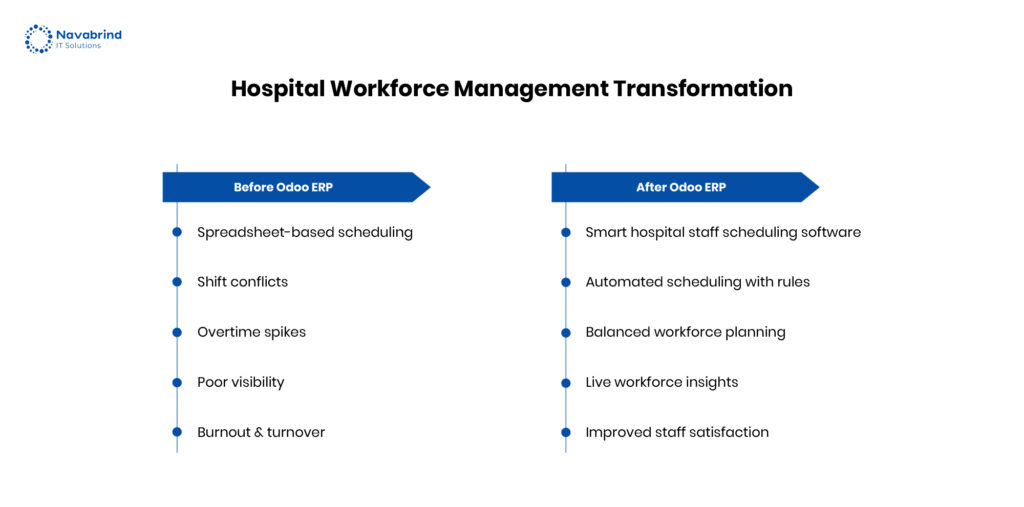
Without a dependable hospital staff scheduling software, hospitals struggle to maintain balance. Overworked nurses face fatigue, unfilled shifts impact service delivery, and administrative teams remain tied up in repetitive coordination tasks.
Smarter Healthcare Workforce Management with Odoo
This is where Odoo ERP changes the approach. Through the HR module in Odoo, hospitals gain a connected system designed to support healthcare workforce management solutions at scale.
Instead of juggling multiple tools, administrators can manage:
- Shift planning through automated staff scheduling for healthcare
- Leave tracking without confusion or overlap
- Attendance monitoring linked with payroll workflows
- Staff records within a centralized environment
For nurse managers exploring how to manage nurse scheduling in hospitals, Odoo introduces a practical and adaptable nurse scheduling software that reduces scheduling pressure and improves workforce visibility.
Building a Sustainable Workforce with the Right ERP
A reliable workforce system is no longer optional. Hospitals need technology that supports people, not just processes.
This blog explores how Odoo ERP for hospital staff management supports:
- End-to-end healthcare workforce management
- Resolution of critical hospital staffing challenges
- Smarter coordination through a connected healthcare vendor management system
- Long-term workforce stability through adaptable scheduling frameworks
For organizations searching for the best ERP for hospital workforce management, this approach shifts the focus from reactive scheduling to proactive workforce planning creating a balanced environment for staff and better outcomes for patients.
The State of Healthcare Workforce Management in 2026
A. The Unique Complexity of Healthcare Staffing
Healthcare staffing demands far exceed the challenges seen in other sectors. Hospitals must align multiple moving parts at once, making healthcare workforce management one of the hardest operational areas to control.
- Clinical competency alignment
Assigning the right mix of professionals like RNs, LPNs, and specialists that match patient acuity is non-negotiable. A gap in skill matching can impact outcomes within hours.
- Regulatory compliance pressure
Hospitals must follow strict staffing ratios, enforce rest periods, and track credentials. Without a dependable hospital staff scheduling software, maintaining compliance becomes a daily struggle.
- 24/7 operational demand
Care delivery never stops. Shift rotations, weekend coverage, and holiday planning require consistent coordination. This is where automated staff scheduling for healthcare plays a critical role in maintaining continuity.
- Unpredictable patient demand
Patient inflow can shift rapidly. Static schedules fail under such pressure. Hospitals need adaptable healthcare workforce management solutions that respond to fluctuations without disruption.
B. The Cost of Doing It Wrong
When healthcare workforce management breaks down, the impact spreads across staff, finances, and patient care.
- Burnout and turnover
Over half of nurses report emotional exhaustion. Replacing staff in a mid-sized hospital can cost millions annually. Poor scheduling practices remain a major contributor to this cycle.
- Financial strain
Ineffective workforce planning leads to missed capacity targets. Hospitals operating without strong nurse scheduling software struggle to align staffing with patient volumes, resulting in lost revenue opportunities.
- Patient safety risks
Staffing gaps and fatigue increase the likelihood of medication errors, extended hospital stays, and reduced patient satisfaction. Workforce mismanagement becomes a clinical risk, not just an operational issue.
C. The Shift Toward Agile Workforce Management
Healthcare organizations are moving toward adaptable systems that support both staff and operations. This shift is redefining how healthcare workforce management is approached.
- Flexible scheduling models
Hospitals are adopting tiered frameworks that balance staff preferences with operational needs. This reduces friction and improves workforce engagement.
- Self-service workforce tools
Staff expect control over their schedules. Digital platforms allow nurses to request time off, swap shifts, and pick up open slots without delays for the key capabilities within Odoo ERP for hospital staff management.
- Data-driven staffing decisions
Predictive insights help forecast patient demand and adjust staffing levels in advance. This strengthens planning and reduces last-minute disruptions.
- Digital transformation in operations
Hospitals are moving away from paper-based coordination toward connected systems like the Odoo ERP, which combines the hr module in odoo with scheduling, attendance, and payroll into a unified environment. Integration with a healthcare vendor management system further strengthens workforce planning by aligning external staffing partners with internal schedules.
Key Insight
“The future of healthcare workforce management depends on building systems that support care teams, reduce scheduling friction, and enable timely, high-quality patient outcomes.”
Common Hospital Staffing Problems and How Odoo Solves Them
Hospitals need structured healthcare workforce management to reduce scheduling inefficiencies, improve staff coordination, and maintain care quality. The table below outlines key hospital staff scheduling problems and solutions, along with how Odoo ERP addresses them through the hr module in odoo and integrated hospital staff scheduling software capabilities.
|
Problem
|
Impact
|
Odoo Solution
|
|
Manual schedule creation
|
Nurse managers spend 8–12 hours per week building and adjusting schedules, reducing focus on patient care
|
Automated staff scheduling for healthcare with shift templates, rotation rules, and conflict detection reduces time spent on scheduling and strengthens healthcare workforce management solutions
|
|
Difficulty filling open shifts
|
Overtime costs rise, agency dependency increases, and units face staffing gaps
|
Built-in nurse scheduling software supports self-service shift bidding, allowing staff to claim open shifts via mobile and managers to approve instantly
|
|
Time-off request chaos
|
Email chains, overlapping requests, and missed approvals create confusion
|
Integrated leave management in the hr module in odoo enables online requests, quick approvals, and instant schedule updates
|
|
Poor skill matching
|
Staff assigned outside their competency increases clinical risk and affects care quality
|
Skills and certification tracking ensures only qualified staff are assigned shifts, addressing key concerns around how to manage nurse scheduling in hospitals
|
|
No visibility into staffing gaps
|
Reactive decisions lead to last-minute scheduling pressure and operational disruption
|
Dashboards provide live insights into open shifts, absence patterns, and coverage levels, improving control over healthcare workforce management
|
|
Compliance risks
|
Missed certifications, overtime violations, and staffing ratio issues increase operational risk
|
Alerts for expiring credentials and rule-based scheduling ensure compliance within healthcare workforce management solutions
|
|
Disconnected systems
|
Scheduling data does not align with payroll, causing errors and delays
|
Connected system linking attendance, scheduling, and payroll makes Odoo ERP for hospital staff management a strong choice for the best ERP for hospital workforce management.
|
The HR Module in Odoo: A Deep Dive for Healthcare
A. Overview of Odoo’s HR Capabilities
The HR module in Odoo delivers a connected system that supports the full employee lifecycle from hiring to performance tracking and payroll. For hospitals, this becomes a critical foundation for healthcare workforce management.
Though not limited to healthcare, the platform can be configured to handle complex staffing environments, making Odoo ERP a strong fit for organizations searching for the best ERP for hospital workforce management.
B. Key Features for Healthcare Workforce Management
1. Employee Records Management
A centralized database forms the backbone of healthcare workforce management solutions.
- Digital profiles for each staff member
- Job roles, departments, and contact details stored in one place
- Emergency contact information for quick access
- Certification and license tracking with expiry alerts
- Documentation of skills, specialties, and competencies
This structure supports accurate staffing decisions and strengthens hospital staff scheduling software by ensuring qualified personnel are assigned to the right roles.
2. Leave Management System
Handling time-off requests without confusion is critical for smooth operations.
- Staff submit leave requests through the system
- Custom leave categories such as vacation, sick leave, CME, and personal days
- Approval workflows aligned with department policies
- Instant visibility into staff availability
This feature addresses common hospital staff scheduling problems and solutions, reducing conflicts and improving planning accuracy.
3. Time and Attendance Tracking
Accurate attendance data plays a key role in healthcare workforce management.
4. Payroll Processing
Payroll accuracy depends on reliable workforce data.
- Salary calculations based on attendance and leave records
- Support for hourly, salaried, and per diem staff
- Tax calculations and deductions
- Connection with accounting systems for financial tracking
For hospitals using Odoo ERP for hospital staff management, this reduces payroll discrepancies and administrative overhead.
5. Recruitment Toolkit
Hiring the right talent is a continuous need in healthcare.
- Publish job openings across platforms
- Track applications and candidate progress
- Manage interview scheduling
- Support onboarding and orientation workflows
This feature helps maintain staffing levels and supports long-term healthcare workforce management solutions.
6. Performance Appraisal
Tracking staff performance improves retention and engagement.
- Custom evaluation templates including 360-degree feedback
- Goal-setting frameworks
- Automated reminders for review cycles
- Link performance insights with promotions and compensation
This creates a feedback-driven culture and supports workforce stability.
C. The Power of Integration
The real strength of Odoo ERP for hospital staff management lies in how different functions connect within one system, strengthening healthcare workforce management at scale. Integration with a healthcare vendor management system extends this capability by aligning external staffing with internal workforce planning.
- Scheduling + Attendance
Shift plans reflect in attendance records, ensuring alignment between planned and actual work hours
- Attendance + Payroll
Logged hours flow into payroll calculations without data gaps
- Employee Records + Compliance
Expiring certifications trigger alerts, reducing compliance risks
- HR + Finance
Labor costs are mapped to departments or cost centers for better financial tracking
Real-World Impact
Healthcare organizations adopting Odoo have reported improved staff allocation and stronger scheduling outcomes. In some cases, facilities achieved millions in annual operational savings through better workforce planning and reduced inefficiencies.The hr module in odoo transforms fragmented workforce processes into a connected system. For hospitals aiming to improve healthcare workforce management, it delivers the visibility, control, and adaptability needed to manage complex staffing environments.
Nurse Scheduling Software: What Odoo Delivers
A. The Evolution of Nurse Scheduling
Healthcare scheduling has moved far beyond basic calendars. Hospitals now require nurse scheduling software that supports complex operational demands and strengthens healthcare workforce management. These expectations define how hospitals approach how to manage nurse scheduling in hospitals today.
A capable system must:
- Handle varied shift formats such as 8-hour, 12-hour, and rotating schedules
- Align with union rules and contractual obligations
- Maintain fairness in shift distribution
- Adjust staffing based on changing patient volumes
- Give nurses control through self-service tools
B. Odoo’s Nurse Scheduling Capabilities
1. Automated Schedule Generation
The scheduling engine within Odoo ERP processes multiple workforce variables at once.
- Inputs include staff availability, preferences, competencies, and policy rules
- The system generates optimized schedules based on defined conditions
- Reduces time spent on repetitive scheduling tasks
This capability strengthens automated staff scheduling for healthcare and supports scalable healthcare workforce management solutions.
2. Self-Service Shift Management
Empowering staff improves engagement and reduces administrative workload.
- Nurses can view schedules, request leave, and claim open shifts through mobile access
- Shift swaps can be managed within the system
- Managers approve requests quickly without long communication chains
This approach resolves key hospital staff scheduling problems and solutions related to coordination delays.
3. Equity and Fairness
Balanced scheduling improves morale and reduces conflict.
- Workload distribution across weekends, holidays, and less preferred shifts is managed systematically
- Transparency in schedule creation builds trust among staff
This makes the nurse scheduling software within Odoo ERP for hospital staff management a dependable option for maintaining fairness.
4. Real-Time Visibility
Workforce visibility is essential for strong healthcare workforce management.
- Managers can identify staffing gaps without delay
- Staff have full clarity on upcoming shifts
- Calendar synchronization supports work-life balance
This visibility reduces last-minute disruptions and improves planning accuracy.
5. Compliance Enforcement
Healthcare scheduling must meet strict regulatory requirements.
- Configurable rules prevent overtime violations
- Skill-based assignment ensures appropriate staffing on each shift
- Staffing ratios are maintained within defined limits
These controls reduce compliance risks and strengthen healthcare workforce management solutions.
C. What Leading Healthcare Systems Are Doing
Top healthcare organizations demonstrate how advanced scheduling systems improve workforce outcomes:
- HCA Healthcare developed the Timpani platform with nurse input, achieving high approval rates for scheduling preferences, reducing administrative workload, and enabling mobile-based access.
- Duke University Hospital implemented a census projection tool that improved staffing alignment with patient volumes and reduced workload variability.
- Mercy Medical Center emphasized involving frontline nurses in software decisions, leading to stronger adoption and support from nurse managers.
These examples highlight a critical shift: successful healthcare workforce management depends on systems that support staff needs while maintaining operational control.
A. Understanding VMS in Healthcare
A healthcare vendor management system supports hospitals in managing relationships with staffing vendors and contingent workers such as agency nurses and locum professionals. It helps track contracts, monitor credentials, and evaluate vendor performance by the key components of effective healthcare workforce management. For hospitals addressing hospital staff scheduling problems and solutions, integrating vendor data into workforce planning is essential to maintain staffing balance.
Key Distinction:
- MSP (Managed Service Provider): A service partner responsible for handling external workforce operations
- VMS (Vendor Management System): The technology platform that enables tracking, reporting, and coordination
B. How Odoo Supports Vendor Management
Although Odoo ERP does not include a dedicated healthcare VMS module, its flexible structure allows hospitals to configure a functional healthcare vendor management system within the hr module in odoo and related applications. This approach connects vendor operations with hospital staff scheduling software, improving coordination between internal teams and external staffing partners.
- Track contingent workers
Create profiles for agency staff with controlled access. This ensures visibility across the extended workforce within healthcare workforce management solutions.
- Manage vendor contracts
Store agreements, rate cards, and service terms in one place for easy reference and governance.
- Track workforce costs
Allocate agency staffing expenses to departments or cost centers. This supports financial planning within Odoo ERP for hospital staff management.
- Monitor credentialing
Track certifications and expiry dates for external staff alongside permanent employees, ensuring compliance across the workforce.
- Generate workforce reports
Analyze vendor usage, staffing costs, and fill rates to guide operational decisions.
C. The Strategic Value
Managing a blended workforce that has permanent staff and contingent workers who have become a critical aspect of healthcare workforce management. A unified system provides stronger visibility and control.
- Total workforce visibility
Track permanent employees, agency staff, and locum professionals within one platform. This supports better planning and reduces fragmentation.
- Cost optimization
Compare staffing options like overtime, agency hiring, or permanent recruitment by using data insights. This improves decision-making across healthcare workforce management solutions.
- Compliance assurance
Ensure that all workers meet credentialing and regulatory requirements, regardless of employment type.
How to Manage Nurse Scheduling in Hospitals: A Step-by-Step Approach with Odoo
Managing nurse schedules requires a structured system that aligns staff availability, patient demand, and compliance requirements. This step-by-step framework shows how hospitals can strengthen healthcare workforce management using Odoo ERP and its hr module in Odoo.
Step 1: Define Your Scheduling Rules
Start by setting a strong foundation for hospital staff scheduling software.
- Identify shift types, durations, and rotation patterns
- Define skill mix requirements for each unit
- Establish rules for overtime, weekend rotations, and holiday coverage
- Configure these rules within Odoo’s scheduling engine
Clear rule definition reduces confusion and creates consistency in healthcare workforce management solutions.
Step 2: Empower Staff with Self-Service
Engaged staff contribute to smoother scheduling outcomes.
- Enable mobile access for clinical teams
- Train staff to submit availability, time-off requests, and shift preferences
- Introduce shift bidding for open slots
This step improves participation and addresses common hospital staff scheduling problems and solutions related to communication gaps.
Step 3: Automate Schedule Generation
Move away from time-consuming scheduling practices.
- Input staff availability, competencies, and preferences
- Use automated staff scheduling for healthcare to generate optimized rosters
- Review and publish schedules 4–6 weeks in advance
This approach strengthens planning accuracy and supports scalable healthcare workforce management.
Step 4: Implement Predictive Staffing
Align staffing levels with patient demand.
- Use historical patient data to forecast volume trends
- Adjust staffing based on projected census
- Maintain flexibility to increase or reduce coverage as needed
This step improves decision-making and enhances the effectiveness of nurse scheduling software.
Step 5: Integrate with Payroll and Finance
Workforce data must connect with financial operations.
- Ensure attendance data flows into payroll processing
- Track labor costs across departments, units, and shift types
- Monitor overtime and premium pay using live data
This integration makes Odoo ERP for hospital staff management a strong option for organizations seeking the best ERP for hospital workforce management.
Step 6: Continuously Improve
Sustainable healthcare workforce management solutions rely on ongoing refinement.
- Collect feedback from nurse managers and staff
- Analyze scheduling data to identify trends and gaps
- Adjust rules and configurations based on operational insights
Continuous improvement ensures the system evolves with changing hospital needs.
Best ERP for Hospital Workforce Management: Why Odoo Stands Out
Choosing the best ERP for hospital workforce management requires evaluating how well a system supports scheduling, integration, flexibility, and compliance. The table below highlights how Odoo ERP performs across key criteria and why it strengthens healthcare workforce management.
|
Evaluation Criteria
|
Odoo ERP
|
Key Advantage for Healthcare Workforce Management
|
|
Scheduling Automation
|
Advanced leave management, shift scheduling, mobile access
|
Reduces time spent on roster creation by 50–80% through automated staff scheduling for healthcare and integrated hospital staff scheduling software
|
|
Integration Capabilities
|
Connected HR, payroll, and finance workflows
|
Creates a single system for workforce data, improving accuracy across healthcare workforce management solutions
|
|
Flexibility
|
Configurable workflows with no-code options
|
Adapts to different care environments—from small clinics to multi-location hospitals using the hr module in odoo
|
|
Cost
|
Lower total cost with modular pricing
|
Supports scaling without heavy upfront investment, making Odoo ERP for hospital staff management accessible across organizations
|
|
Mobile Access
|
Mobile-friendly interface
|
Enables staff to manage shifts, leave, and availability remotely through nurse scheduling software capabilities
|
|
Compliance Support
|
Rule-based scheduling, certification tracking, audit logs
|
Strengthens regulatory adherence within healthcare workforce management and reduces risk exposure
|
|
VMS Capabilities
|
Configurable but not pre-built
|
Can support a healthcare vendor management system through customization for contingent workforce tracking
|
Hospitals evaluating the best ERP for hospital workforce management need a system that balances control, adaptability, and workforce visibility. With strong scheduling capabilities, connected workflows, and support for healthcare workforce management solutions, Odoo delivers a reliable foundation for managing complex hospital staffing needs.
Automated Staff Scheduling for Healthcare: The Future
A. AI and Machine Learning in Workforce Management
Healthcare organizations are adopting AI-driven approaches to strengthen healthcare workforce management and reduce operational strain. These technologies support smarter planning and better alignment between staff availability and patient demand.These advancements are reshaping automated staff scheduling for healthcare, shifting hospitals toward proactive workforce planning instead of reactive adjustments.
- Predict patient volumes
Forecast admissions, discharges, and transfers to prepare staffing levels in advance
- Optimize staffing levels
Align workforce capacity with projected patient census using data-driven models
- Reduce clinician burden
Minimize administrative workload by automating repetitive coordination tasks
B. The Role of Odoo in the AI-Powered Future
The architecture of Odoo ERP supports integration with AI-driven tools, making it a strong foundation for evolving healthcare workforce management solutions. This flexibility strengthens Odoo ERP for hospital staff management, enabling organizations to extend beyond traditional scheduling systems.
- Third-party integrations
AI-based scheduling engines can connect with the hr module in odoo, enhancing nurse scheduling software capabilities with predictive insights
- API-driven ecosystem
Hospitals can build custom models that feed staffing recommendations into scheduling workflows
- Data foundation for AI
Clean, structured workforce data within Odoo improves the accuracy of AI predictions and insights
C. What’s Next in Healthcare Workforce Management
The next phase of automated staff scheduling for healthcare will focus on predictive, adaptive, and staff-centric systems.These innovations address long-standing hospital staff scheduling problems and solutions, helping hospitals maintain stability and improve staff satisfaction.
- Intelligent shift recommendations
AI suggests the ideal staff for open shifts based on skills, location, and preferences
- Acuity-based staffing adjustments
Staffing levels adjust dynamically as patient conditions change across units
- Predictive retention analytics
Identify early signs of burnout or disengagement, allowing timely intervention
Odoo ERP for Hospital Staff Management: Real-World Results
Case Example: Canadian Healthcare Facilities
Challenge:
Healthcare facilities faced fragmented operations due to disconnected systems. Patient data remained scattered, workforce coordination relied on repetitive processes, and staffing gaps created delays in care delivery. These issues made effective healthcare workforce management difficult to sustain.
Solution:
Organizations implemented a unified system using Odoo ERP, combining the HRmodule in Odoo with scheduling, payroll, and performance tracking. This approach strengthened Odoo ERP for hospital staff management by connecting workforce processes within one platform.
Results
- Improved staff scheduling and allocation
Hospitals gained better control over shift planning using hospital staff scheduling software, reducing staffing gaps and improving workforce balance
- Faster patient processing
Streamlined coordination between departments reduced wait times and improved care delivery
- Improved billing accuracy and compliance
Integrated workflows ensured accurate financial tracking with audit-ready records
- Over $9 million in annual operational savings
Better workforce planning and reduced inefficiencies delivered measurable financial impact
Key Takeaway
Real-world adoption of healthcare workforce management solutions shows that connected systems drive measurable improvements. With Odoo ERP for hospital staff management, hospitals can reduce operational inefficiencies, improve staff satisfaction, and deliver consistent patient care outcomes.
How to Choose the Right ERP for Your Healthcare Workforce
Selecting the best ERP for hospital workforce management depends on organization size, staffing complexity, and operational priorities. A scalable platform like Odoo ERP supports different stages of growth through its flexible healthcare workforce management solutions.
This setup provides a strong starting point for clinics exploring how to manage nurse scheduling in hospitals without heavy system complexity.
For Small Clinics and Practices (2–20 Staff)
Priority focus:
- Cost-conscious setup
- Quick deployment
- Core healthcare workforce
management functionality
Odoo Fit:
- Start with employee records and the hr module in odoo
- Add leave management and basic hospital staff scheduling software as needed
- Expand features as operations grow
Implementation Timeline:
This stage benefits from structured healthcare workforce management, helping reduce scheduling conflicts and improve workforce visibility
For Mid-Size Hospitals (20–200 Staff)
Priority focus:
- Automated staff scheduling for healthcare
- Shift bidding and self-service access
- Skills and certification tracking
- Payroll integration
Odoo Fit:
- Full HR suite with advanced nurse scheduling software capabilities
- Configurable scheduling rules to handle complex staffing needs
- Integrated payroll and attendance tracking
Implementation Timeline:
This approach supports complex environments where centralized control and distributed workforce coordination are critical.
For Large Hospital Networks (200+ Staff, Multiple Sites)
Priority focus:
- Workforce analytics and reporting
- Multi-location workforce coordination
- Integration with a healthcare vendor management system
- AI-driven workforce planning
Odoo Fit:
- Scales across multiple facilities using Odoo ERP for hospital staff management
- Supports customization for enterprise-level scheduling and reporting
- Integrates with external systems for extended healthcare workforce management solutions
Implementation Timeline:
Key Takeaway
Choosing the best ERP for hospital workforce management depends on aligning system capabilities with operational needs. With a scalable platform like Odoo, healthcare organizations can start with core features and expand into advanced healthcare workforce management solutions as their workforce grows.
The Odoo Advantage
Odoo ERP delivers a connected approach to healthcare workforce management solutions, helping hospitals move beyond fragmented systems.
- A unified platform covering employee records, hospital staff scheduling software, attendance, leave, and payroll through the HR module in Odoo
- Flexibility to begin with essential features and expand as workforce needs evolve
- A cost-conscious alternative to legacy systems for Odoo ERP for hospital staff management
- Integration across workforce, finance, and operations for better decision-making
This combination supports hospitals searching for the best ERP for hospital workforce management while maintaining scalability.
With automated staff scheduling for healthcare, integrated workforce data, and adaptable nurse scheduling software, Odoo provides a foundation for long-term workforce stability.
Odoo ERP for hospital staff management goes beyond system implementation—it enables a sustainable, people-focused approach to healthcare workforce management that supports staff, strengthens operations, and improves patient experience.
Frequently Asked Questions
1. Is Odoo suitable for nurse scheduling in a 24/7 hospital environment?
Yes. Odoo ERP supports continuous hospital operations and handles complex scheduling needs within healthcare workforce management. Hospitals can configure multiple shift types, including rotating schedules, weekend coverage, and holiday planning. The hr module in odoo allows administrators to apply rules for overtime limits, rest periods, and skill-based assignments. With automated staff scheduling for healthcare, nurse managers can generate schedules that align with staffing requirements and patient demand, reducing workload and improving consistency.
2.Can Odoo track staff certifications and licensure?
Yes. Odoo provides strong support for compliance tracking as part of healthcare workforce management solutions. Employee profiles store certifications, licenses, and training records, along with expiry dates and alerts for renewals. This ensures that only qualified staff are assigned to shifts through hospital staff scheduling software. It helps hospitals address critical hospital staff scheduling problems and solutions related to compliance gaps and workforce readiness.
3.Does Odoo integrate with payroll systems?
Yes. Odoo includes an integrated payroll system that connects workforce data with financial processes. Salary calculations are based on attendance, shift data, and leave records, supporting hourly, salaried, and per diem structures. Overtime, shift differentials, and additional pay components are tracked accurately. This connection strengthens Odoo ERP for hospital staff management by ensuring that payroll aligns with workforce activity and supports consistent healthcare workforce management.
4.Can staff access schedules via mobile?
Yes. Odoo offers mobile access that allows staff to stay connected with their schedules at all times. Nurses can view shifts, submit leave requests, update availability, and participate in shift bidding using nurse scheduling software features. This improves communication and supports flexible healthcare workforce management solutions, helping staff stay informed without delays.
5.What about agency staff and vendor management?
Odoo can support a healthcare vendor management system through configuration and integration. Hospitals can create profiles for agency staff, track vendor contracts, and monitor certifications alongside permanent employees. Workforce costs related to external staffing can be analyzed within the system. For extended capabilities, third-party integrations can enhance vendor tracking. This approach ensures complete visibility across internal and external staffing, strengthening overall healthcare workforce management.
6. How easy is it to train people on Odoo ERP
Odoo ERP for SMEs is designed to help users learn the application quickly.
- Comprehensive Documentation: Odoo provides extensive online resources, tutorials, and manuals to guide users through functions and features.
- Customizable Dashboards: Personalized dashboards help users focus on relevant tasks, reducing the complexity of learning multiple features.
Interactive Community
- Support: A large Odoo community offers forums, webinars, and peer support, helping users resolve issues and learn quickly.
- Training Programs and Certifications: Odoo offers structured training and certification courses to ensure in-depth knowledge transfer.
- Training from the Implementation Partner: Once deployed, ensure your implementation partner trains your teams in areas where Odoo is customized.
- Hands-on Learning: Odoo’s live demos and test environments provide users with practical experience and allow them to learn by doing.
Schedule a conversation with us now!
Related Articles






 Post
Post