In 2026, healthcare providers across the United States are navigating a challenging environment shaped by complex reimbursement frameworks, and rising expectations around digital care delivery. Medicare improper payment rates reached 21.4% in 2024, resulting in $1.9 billion in billing errors highlighting how fragile revenue cycle management can become without the right systems in place.
This is where ERP for hospitals in the US plays a defining role. Healthcare organizations are no longer evaluating ERP as a back-office upgrade. They are turning to ERP for hospitals and clinics to manage financial workflows, patient data, compliance obligations, and operational visibility within an ecosystem.
At the same time, regulatory pressure around HIPAA compliance and patient data security continues to intensify. Without a connected system, maintaining audit trails, securing sensitive records, and ensuring billing accuracy becomes increasingly difficult. This is why selecting the right platform through a Healthcare ERP software comparison is a business-critical decision.
The Dilemma
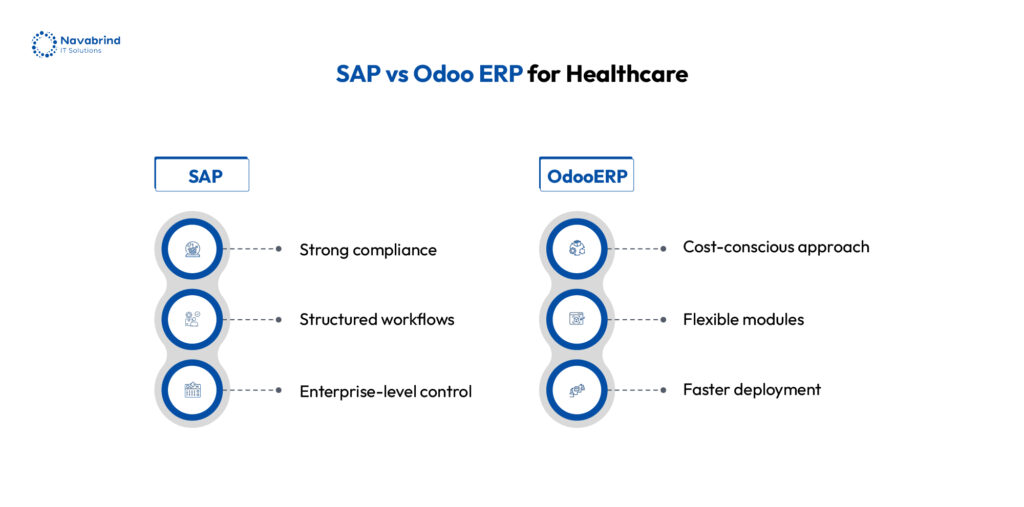
On one side is SAP, known for its enterprise grade architecture and strong compliance capabilities. It has long been a preferred choice for large hospital networks that require control over financial reporting and regulatory adherence.
On the other side is Odoo, gaining traction as a flexible and cost-conscious alternative. With the Odoo Healthcare module, organizations can manage patient interactions, billing processes, and operational workflows without the complexity that traditional systems bring. This has made Odoo ERP implementation healthcare projects relevant for mid-sized hospitals and clinics looking for agility.
This growing debate around SAP vs Odoo ERP reflects a shift in how healthcare providers evaluate technology while balancing compliance, cost, adaptability, and speed of deployment.
This blog presents a detailed Healthcare ERP software comparison, focusing on SAP vs Odoo ERP in the context of ERP for hospitals in the US. It explores key decision factors including cost structure, deployment timelines, healthcare-focused capabilities, and compliance readiness.
By examining how each platform supports ERP for hospitals and clinics, along with insights into Odoo ERP implementation healthcare and the capabilities of the Odoo Healthcare module, this guide will help you identify which solution aligns with your organization’s scale, budget, and long-term growth direction.
The US Healthcare ERP Landscape: What Makes It Different?
Why Healthcare ERPs Are Unique:
Healthcare operations in the United States demand more than standard business software can handle. This is why ERP for hospitals in the US is designed with requirements that go beyond finance and inventory.
Patient data security
Protecting patient information is a legal obligation, not a choice. HIPAA regulations require strict control over access, data storage, and audit trails. Any ERP for hospitals and clinics must support encryption, role-based permissions, and detailed activity logs to reduce compliance risk.
Complex billing cycles
Healthcare billing involves multiple stakeholders in Medicare, Medicaid, private insurers, and patients. Each follows different rules, timelines, and documentation standards. Without a tailored system, errors increase, leading to revenue leakage. This is why a strong Healthcare ERP software comparison must evaluate how platforms handle billing workflows and claim management.
Inventory traceability
Hospitals manage sensitive inventory such as medical devices and pharmaceuticals. These require batch tracking, lot control, and expiry monitoring. In a healthcare setup, inventory is not just about stock levels, it is about patient safety and regulatory accountability. Systems like the Odoo Healthcare module address these requirements with traceability features that align with clinical operations.
Multi-location complexity
Hospital networks rarely operate from one location, they include main hospitals, outpatient facilities, labs, and specialty centers. Managing data across these units requires centralized visibility without losing operational control at each site. This is a critical factor when evaluating ERP for hospitals and clinics, especially during Odoo ERP implementation healthcare projects or large-scale deployments.
Key Insight
Healthcare organizations cannot rely on generic ERP systems. The level of compliance, operational depth, and data sensitivity involved demands a tailored approach.
When comparing SAP vs Odoo ERP, the difference lies in how each platform addresses these challenges. SAP leans toward rigid, compliance-driven frameworks suited for large-scale environments. Odoo, through the Odoo Healthcare module and flexible configuration approach, offers a different path by focusing on adaptability and faster alignment with operational needs.
A thoughtful Healthcare ERP software comparison should not just list features. It should evaluate how well each system supports the realities of ERP for hospitals in the US, from compliance to billing to multi-location coordination.
SAP Business One for Healthcare: The Enterprise-Grade Solution
What Is SAP Business One ERP System?
SAP Business One is an integrated ERP platform designed for growing organizations that require structured financial control, operational visibility, and compliance readiness. Within healthcare, it serves as a foundation for hospitals and clinics that need governance without stepping into the scale of S/4HANA.
SAP Business One gains healthcare relevance through partnerships with specialized solution providers such as VRTCL Consulting. Their VRTCL Medical Suite extends SAP’s capabilities to support clinical and administrative workflows, including revenue cycle management and medical records integration.
When evaluating SAP vs Odoo ERP, SAP Business One stands out for its disciplined architecture and compliance-driven design, which appeals to organizations managing complex regulatory and financial environments.
Key Healthcare Features
Hospitalization operations management
The platform supports end-to-end patient handling from admission to discharge. This includes informed consent tracking, insurance agreements, advance payment handling, and continuous monitoring of patient balances. These capabilities strengthen financial control within ERP for hospitals and clinics, reducing gaps in billing and documentation.
Healthcare plan management
SAP enables rule-based configuration for handling different payer types, including government programs, private insurance, and local healthcare plans. Automated balance calculations help minimize billing discrepancies, which is a key consideration in any Healthcare ERP software comparison.
Appointment and consultation management
The system supports appointment booking, physician allocation based on specialty, and queue handling through ticket-based monitoring. It connects patient visits with insurance plans and clinical resources, creating a structured flow across departments.
Inventory and stock integration
Through SAP’s inventory framework, hospitals can track medical supplies and pharmaceuticals with batch-level control and expiration date monitoring. This level of traceability is essential for regulatory compliance and patient safety in ERP for hospitals in the US.
Who Is It For?
SAP Business One is suited for healthcare organizations that require process control and have the resources to support a structured ERP environment.
- Large hospitals with 550+ beds
- Multi-location hospital networks requiring centralized oversight
- Organizations dealing with complex compliance and reporting requirements
- Healthcare providers with strong IT budgets, typically starting from $50K annually for ERP investment
In a SAP vs Odoo ERP evaluation, SAP Business One aligns with organizations that prioritize governance, financial discipline, and standardized workflows. For healthcare providers comparing platforms through a Healthcare ERP software comparison, SAP represents a path focused on control and regulatory alignment within ERP for hospitals and clinics.
Odoo ERP for Healthcare: The Agile Alternative
What Is Odoo ERP for Hospitals and Clinics?
Odoo is a modular, open-source ERP platform that adapts to healthcare through configurable applications and community-driven extensions. For organizations exploring ERP for hospitals and clinics, Odoo presents a flexible path that supports clinical workflows, administrative processes, and financial management within one environment.
The platform becomes healthcare-ready through the Odoo Healthcare module and third-party Hospital Management System (HMS) extensions developed by its global community. These modules enable healthcare providers to manage patient interactions, appointments, billing, and records without the rigidity seen in traditional ERP systems.
In a SAP vs Odoo ERP evaluation, Odoo appeals to organizations looking for adaptability, faster deployment, and controlled spendings especially when planning an Odoo ERP implementation healthcare project.
Key Healthcare Features
Patient Management
Odoo supports detailed patient registration, capturing personal details, contact information, and medical background. It includes medical history tracking, allergy records, emergency contacts, blood group data, and vital statistics. The system calculates age based on date of birth, helping maintain accurate patient profiles within ERP for hospitals in the US.
Doctor Management
The platform enables creation of detailed doctor profiles, including specialization, qualifications, and department mapping. It tracks license numbers, consultation fees, and professional experience, ensuring that healthcare providers maintain organized clinical records.
Appointment Scheduling
Odoo offers a calendar-based appointment system that allows healthcare staff to manage bookings with defined time slots and durations. Appointment statuses such as draft, confirmed, in progress, completed, and cancelled that help track patient flow across departments. This capability plays a key role in improving operational visibility in ERP for hospitals and clinics.
Medical Records Management
The Odoo Healthcare module supports structured medical record management, including vital signs such as temperature, blood pressure, heart rate, weight, and height. It allows healthcare professionals to document diagnoses, treatments, and prescriptions, along with scheduling follow-ups. This creates continuity in patient care and supports compliance requirements evaluated in any Healthcare ERP software comparison.
Department Management
Hospitals can organize departments, assign department heads, and map doctors to relevant units. This ensures better coordination across clinical teams and improves internal workflow alignment during Odoo ERP implementation healthcare initiatives.
Security Groups and Access Control
Odoo provides role-based access through defined user groups:
- HMS User: Access to create and view records
- HMS Doctor: Access to manage medical records and consultations
- HMS Manager: Full administrative control
This structure helps maintain data security and operational accountability within ERP for hospitals in the US.
Who Is It For?
Odoo is well-suited for healthcare organizations that value flexibility and controlled investment.
- Small to mid-sized clinics with 2–50 providers
- Outpatient centers and specialty practices
- Budget-conscious healthcare organizations evaluating Healthcare ERP software comparison options
- Organizations with in-house IT teams or access to Odoo implementation partners for customization
Head-to-Head Comparison: SAP vs. Odoo ERP for Healthcare
Cost Comparison: SAP Business One vs Odoo ERP
The cost difference between SAP Business One and Odoo is not just about pricing as it reflects how each platform approaches deployment, customization, and long-term ownership. For healthcare organizations evaluating ERP for hospitals in the US, understanding these cost layers is critical before making a decision.
Below is a detailed breakdown based on your data, expanded with practical context:
|
Cost Category
|
SAP Business One
|
Odoo ERP
|
|
Software Licensing
|
High entry cost with per-user licensing. Requires a minimum contract period (commonly 2 years) and a base user package (around 10 users). Licensing structure is rigid and scales with user count.
|
Lower entry barrier. Community edition available without licensing fees. Enterprise version priced per user/month (~$20–30). Flexible scaling based on usage.
|
|
Implementation Cost
|
Significant upfront investment ($50K–$150K+). Requires certified SAP consultants and healthcare-specific integration expertise. Longer setup due to structured configuration and compliance alignment.
|
Lower implementation range ($5K–$30K). Can be deployed through partners or internal IT teams. Faster setup due to structure and configurable healthcare extensions.
|
|
Maintenance & Support
|
Ongoing costs remain high. Annual support contracts required. Dependence on specialized SAP consultants for updates, fixes, and compliance adjustments.
|
Lower maintenance burden. Community support available, with optional partner support at controlled cost. Updates and enhancements are easier to manage.
|
|
Customization Cost
|
Customization involves higher cost due to proprietary architecture. Changes require certified developers and longer development cycles.
|
Customization is more accessible. Open-source framework allows faster modifications through developers or partners during Odoo ERP implementation healthcare projects.
|
|
Scalability Cost Impact
|
Scaling increases cost significantly due to licensing, infrastructure, and consulting dependencies. Best suited for large-scale expansion with strong budgets.
|
Scaling is cost-controlled. Organizations can add users, modules, or features without major financial strain, making it suitable for growing healthcare setups.
|
|
3-Year Total Cost of Ownership
|
Estimated between $150K–$500K+, depending on scale, customization, and support requirements.
|
Estimated between $15K–$75K, depending on deployment model and support choices.
|
Implementation Timeline Comparison: SAP Business One vs Odoo ERP
The implementation timeline has an impact on how quickly a healthcare organization can start seeing value from its ERP system. In the context of ERP for hospitals in the US, delays in deployment can affect billing cycles, patient management, and compliance readiness.
Below is a detailed breakdown of the implementation phases, with added clarity on what each stage involves and how SAP vs Odoo ERP differs in execution:
|
Implementation Phase
|
SAP Business One
|
Odoo ERP
|
|
Discovery & Planning
|
4–8 weeks. Involves extensive requirement analysis, compliance mapping, and workflow documentation. Multiple stakeholder approvals are required due to structured governance.
|
1–2 weeks. Focused requirement gathering with faster decision cycles. Suitable for organizations adopting ERP for hospitals and clinics with defined workflows.
|
|
Configuration
|
8–12 weeks. System configuration follows a structured approach with strict alignment to predefined processes. Customization requires technical expertise and validation cycles.
|
2–4 weeks. Configuration is faster due to the setup of the Odoo Healthcare module. Features can be enabled and adjusted based on operational needs.
|
|
Data Migration
|
4–8 weeks. Data transfer from legacy systems involves validation, cleansing, and compliance checks. High dependency on consultants to maintain accuracy.
|
1–3 weeks. Data migration is quicker, especially for mid-sized setups. Tools and scripts simplify transfer during Odoo ERP implementation healthcare projects.
|
|
Testing & Training
|
4–6 weeks. Includes multiple testing cycles, user acceptance testing, and structured training sessions across departments.
|
1–2 weeks. Shorter testing cycles with faster onboarding for staff due to simpler interface and workflows.
|
|
Total Timeline
|
6–12 months. Longer duration due to structured deployment, compliance validation, and layered approvals.
|
4–12 weeks. Faster rollout allows organizations to start using key functions early and expand over time.
|
Implementation Insight
The timeline difference reflects two distinct approaches in a Healthcare ERP software comparison:
- SAP Business One follows a structured, process-heavy path. This suits large hospitals that require control, detailed validation, and extensive compliance checks before going live.
- Odoo ERP, supported by the Odoo Healthcare module, allows healthcare providers to go live with essential features in a shorter timeframe, then expand functionality as operational needs grow.
For organizations evaluating ERP for hospitals in the US, this difference can influence not just cost, but how quickly improvements in billing, patient management, and reporting start to take effect.
Healthcare-Specific Functionality Comparison: SAP Business One vs Odoo ERP
|
Feature
|
SAP Business One
|
Odoo ERP
|
|
Patient Registration
|
Supports a full admission workflow, including patient onboarding, insurance capture, consent tracking, and financial linkage from the first interaction. Designed to align with hospital intake processes across departments.
|
Covers basic patient registration with medical history capture. Suitable for clinics and smaller setups. Extended admission workflows can be configured during Odoo ERP implementation healthcare.
|
|
Medical Records Management
|
Provides electronic medical records integrated with financial and operational data. Ensures traceability across patient care and billing cycles, which is critical in ERP for hospitals in the US.
|
Offers comprehensive record management including vital signs, diagnosis, and treatment logs. Works well for clinical documentation, with flexibility to expand based on requirements.
|
|
Appointment Scheduling
|
Includes queue management, physician allocation based on specialization, and operational coordination across departments. Designed for high patient volumes in hospital environments.
|
Provides calendar-based scheduling with status tracking (draft, confirmed, completed, etc.). Suitable for managing appointments in outpatient and mid-sized healthcare setups.
|
|
Billing & Insurance
|
Handles automated insurance calculations with strong integration into SAP financial systems. Supports complex payer structures including Medicare and private insurance, making it a key strength in any Healthcare ERP software comparison.
|
Supports invoicing and billing workflows. Insurance handling requires additional configuration or third-party extensions. Suitable for organizations with simpler billing requirements in ERP for hospitals and clinics.
|
|
Pharmacy & Inventory Management
|
Integrated with SAP inventory system, enabling batch tracking, lot control, and expiry management. Ensures compliance and traceability for pharmaceuticals and medical supplies.
|
Provides inventory management with batch and expiry tracking through Odoo modules. Can be extended to meet pharmacy requirements during Odoo ERP implementation healthcare.
|
|
HIPAA Compliance
|
Supported through SAP’s security framework, including access controls, audit logs, and data protection mechanisms aligned with US healthcare regulations.
|
Requires configuration and external security modules to meet HIPAA standards. Flexibility allows compliance setup, though it depends on implementation approach.
|
|
Telemedicine Support
|
Available through VRTCL Medical Suite integration, allowing remote consultation capabilities within the ERP environment.
|
Requires third-party integration to enable telemedicine features. Can be added based on organizational needs.
|
|
Reporting & Analytics
|
Uses SAP BI tools for structured reporting, financial insights, and operational tracking. Suitable for large healthcare networks requiring detailed analytics.
|
Provides dashboards and reporting tools within Odoo. Can integrate with external BI tools for expanded analytics during Odoo ERP implementation healthcare.
|
Functionality Insight
In a SAP vs Odoo ERP comparison, the difference in functionality comes down to approach and adaptability within ERP for hospitals in the US. SAP Business One, when paired with the VRTCL Medical Suite, delivers an integrated healthcare environment where clinical, financial, and compliance processes are closely aligned. This makes it well-suited for large hospitals that deal with complex insurance workflows, multi-payer systems, and strict regulatory requirements. Billing and insurance management stand out as a key strength, offering structured handling of Medicare, private insurance, and other reimbursement models within a single system.
Odoo, supported by the Odoo Healthcare module, takes a more flexible approach. It provides essential healthcare functionality across patient management, appointments, medical records, and inventory, which can be extended during Odoo ERP implementation healthcare based on operational needs. This makes it a practical option for organizations that want adaptability without heavy system constraints. Although billing and insurance workflows may require additional configuration, Odoo allows healthcare providers to shape the system around their processes rather than adjusting operations to fit the software.
For organizations evaluating a Healthcare ERP software comparison, the choice depends on operational complexity and scale. SAP aligns with environments that require process control and integrated financial systems, whereas Odoo fits healthcare providers looking for flexibility and controlled investment in ERP for hospitals and clinics.
Which Is Better: SAP or Odoo ERP for Healthcare?
Choosing between SAP vs Odoo ERP depends on how your organization operates, your budget capacity, and the level of control required across clinical and financial processes. In the context of ERP for hospitals in the US, this decision impacts compliance, billing accuracy, and operational scalability.
Choose SAP Business One If:
- You manage a large hospital (100+ beds) or a multi-location healthcare network that requires centralized control
- Compliance, audit readiness, and regulatory alignment are critical across departments
- Your organization has an ERP investment budget exceeding $100K annually
- You require integrated insurance billing that supports Medicare, Medicaid, and private payer rules without heavy configuration
- Financial consolidation across multiple entities or locations is a priority
SAP Business One, especially when extended with healthcare solutions, aligns with organizations that need a structured system for handling complex operations. In a Healthcare ERP software comparison, it stands out for its alignment with regulatory frameworks and financial discipline required in large-scale ERP for hospitals and clinics.
Choose Odoo ERP If:
- You operate a small to mid-sized clinic, outpatient center, or specialty practice
- Budget control is a key factor, and you prefer paying based on usage and requirements
- You want a faster rollout, with go-live timelines measured in weeks rather than months
- Your organization has internal IT support or works with experienced partners for Odoo ERP implementation healthcare
- You prefer flexibility and customization over rigid workflows
- You plan to start with essential features and expand as your practice grows
With the Odoo Healthcare module, Odoo provides a flexible foundation for managing patient records, appointments, and operations. It fits organizations that prioritize adaptability and controlled investment in ERP for hospitals and clinics.
Final Perspective
There is no universal answer in the SAP vs Odoo ERP decision. The right choice depends on how your healthcare organization balances compliance, cost, and operational flexibility.
Affordable ERP Alternatives to SAP for US Clinics
For smaller healthcare providers evaluating ERP for hospitals in the US, cost and flexibility play a major role in decision-making. Not every clinic requires the depth or investment level associated with SAP. Several alternatives offer practical functionality for ERP for hospitals and clinics, especially for organizations aiming to balance capability with controlled spending.
|
Alternative
|
Best For
|
Key Advantage
|
|
Odoo
|
Small-to-mid-sized clinics, outpatient centers, specialty practices
|
Flexible and modular approach through the Odoo Healthcare module, allowing organizations to start with essential features and expand over time. Well-suited for phased Odoo ERP implementation healthcare with controlled investment.
|
|
Microsoft Dynamics 365 Business Central
|
Mid-sized practices already using Microsoft tools
|
Familiar interface with strong reporting and analytics capabilities. Integrates well with Microsoft ecosystem tools like Excel and Teams, supporting operational visibility.
|
|
Zoho ERP
|
Startups and budget-conscious healthcare providers
|
Lower entry cost with accessible business applications. Suitable for organizations looking to digitize operations quickly within ERP for hospitals and clinics without complex setup requirements.
|
How to Choose the Right ERP for Your Healthcare Organization
Selecting the right system is not just a feature comparison which requires aligning your operational needs, financial capacity, and growth plans. For organizations evaluating ERP for hospitals in the US, the following step-by-step framework brings clarity to the decision process:
Step 1: Assess Your Size and Complexity
Start by evaluating the scale of your operations and how complex your workflows are.
- Small clinics (<10 providers):
Odoo is sufficient, especially with the Odoo Healthcare module supporting patient records, appointments, and basic billing.
- Mid-size practices (10–50 providers):
Odoo with HMS modules remains a strong option. For organizations using Microsoft tools, Dynamics 365 can be considered during a Healthcare ERP software comparison.
- Large hospitals (50+ providers, multiple locations):
SAP Business One, paired with healthcare extensions, aligns better with complex operations and multi-location coordination in ERP for hospitals and clinics.
Step 2: Calculate Total Cost of Ownership
Avoid focusing only on subscription pricing. A complete cost view is critical in a SAP vs Odoo ERP evaluation.
- Include implementation, training, customization, and ongoing support
- SAP deployments may require 2–3x the software cost for implementation and consulting
- Odoo has lower entry cost, though partner fees should be considered if in-house expertise is limited during Odoo ERP implementation healthcare
This step ensures your ERP investment aligns with long-term financial planning.
Step 3: Evaluate Compliance Requirements
Healthcare compliance is non-negotiable, especially under HIPAA regulations.
- If your organization undergoes frequent audits, SAP’s structured security framework offers strong support
- If you have capable IT resources, Odoo can be configured to meet compliance standards at a lower cost
This is a key factor when selecting ERP for hospitals in the US, as compliance gaps can lead to financial and legal risk.
Step 4: Assess Technical Resources
Your internal technical capability will influence implementation success and long-term sustainability.
Step 5: Plan for Growth
Your ERP should support not just current needs but future expansion.
- SAP scales well for large enterprises with complex financial and operational structures
- Odoo allows organizations to start with essential modules and expand functionality as operations grow
This makes Odoo a practical option for evolving ERP for hospitals and clinics, especially for providers aiming to scale without heavy upfront investment.
Odoo ERP Implementation Healthcare: What to Expect
Adopting Odoo in a healthcare environment involves a structured rollout that aligns clinical workflows, administrative processes, and compliance requirements. For organizations exploring ERP for hospitals in the US, understanding each phase of Odoo ERP implementation healthcare helps set realistic expectations and ensures a smoother transition.
|
Implementation Stage
|
What It Involves
|
Impact on Healthcare Operations
|
|
Select a Partner
|
Collaborate with an Odoo partner who understands healthcare workflows, billing structures, and compliance needs.
|
Reduces implementation risks and ensures the system aligns with requirements of ERP for hospitals and clinics.
|
|
Install HMS Modules
|
Deploy the Odoo Healthcare module along with community or third-party Hospital Management System extensions.
|
Enables patient management, appointments, medical records, and billing capabilities from the start.
|
|
Configure Security
|
Set up role-based access controls for doctors, nurses, administrative staff, and billing teams to meet HIPAA requirements.
|
Protects sensitive patient data and supports compliance within ERP for hospitals in the US.
|
|
Migrate Data
|
Transfer patient records, inventory data, financial information, and historical transactions from legacy systems.
|
Maintains continuity of care and financial tracking without data loss.
|
|
Train Staff
|
Conduct role-based training tailored to different users, clinical staff, front desk teams, and finance departments.
|
Improves adoption and reduces operational disruption during transition.
|
|
Go Live
|
Launch the system in phases, starting with key functions such as appointment scheduling and billing before expanding to other modules.
|
Allows teams to adapt gradually while maintaining service quality in ERP for hospitals and clinics.
|
For a mid-sized clinic, Odoo ERP implementation healthcare generally takes 6–12 weeks, depending on customization needs, data complexity, and internal readiness.
In a SAP vs Odoo ERP comparison, Odoo’s implementation approach stands out for its flexibility and faster deployment. Healthcare providers can begin with essential functions and expand gradually, rather than waiting for a full-scale rollout.
For organizations conducting a Healthcare ERP software comparison, this phased approach reduces downtime, lowers risk, and allows quicker adoption of ERP for hospitals in the US making Odoo a practical choice for clinics aiming to balance speed, cost, and operational continuity.
There is no universal answer when selecting an ERP system for healthcare. The right choice depends on how your organization operates, the level of compliance required, and the budget available. For decision-makers evaluating ERP for hospitals in the US, the focus should be on long-term alignment rather than short-term convenience.
A detailed Healthcare ERP software comparison shows that both systems serve different segments of the healthcare landscape. The SAP vs Odoo ERP decision is less about which platform is superior and more about which one fits your operational reality.
|
If You Are…
|
Recommended ERP
|
|
A large hospital with complex billing, insurance workflows, and multi-location operations
|
SAP Business One (with VRTCL Medical Suite)
|
|
A small-to-mid-sized clinic or specialty practice
|
Odoo (with HMS modules and Odoo Healthcare module)
|
|
Budget-conscious with access to in-house IT or implementation partners
|
Odoo, especially for flexible Odoo ERP implementation healthcare
|
|
Focused on compliance, audit readiness, and structured financial control with strong investment capacity
|
SAP Business One
|
For organizations navigating ERP for hospitals and clinics, the decision should reflect operational scale, financial planning, and technical readiness.
- SAP Business One aligns with healthcare providers that require structured processes, strong compliance frameworks, and enterprise-level financial management
- Odoo provides a flexible and scalable path, allowing organizations to start with essential capabilities and expand over time
In the end, a thoughtful SAP vs Odoo ERP evaluation ensures that your ERP system supports not just current operations, but sustainable growth across your healthcare organization.
In the landscape of ERP for hospitals in the US, the decision between SAP vs Odoo ERP comes down to scale, complexity, and financial readiness.
SAP Business One stands out as a premium option for large healthcare organizations that require tight compliance control, integrated insurance billing, and structured financial processes. It fits environments where regulatory demands are high and investment capacity supports a longer deployment cycle along with significant upfront costs. Within a Healthcare ERP software comparison, SAP aligns with institutions that prioritize stability, audit readiness, and end-to-end control across ERP for hospitals and clinics.
Odoo, supported by the Odoo Healthcare module, offers an alternative for small-to-mid-sized healthcare providers. It allows organizations to implement essential capabilities quickly, manage costs effectively, and expand functionality over time through Odoo ERP implementation healthcare. This makes it a strong fit for providers that value adaptability and phased growth without heavy initial investment.
In simple terms:
- Choose SAP when scale, compliance, and financial complexity define your operations
- Choose Odoo when flexibility, speed, and cost control matter most in your ERP for hospitals and clinics journey
Frequently Asked Questions
1. What is the SAP Business One cost for a small hospital?
The cost of SAP Business One goes beyond licensing by reflecting a full-scale investment in a structured ERP environment. For a small hospital, annual software licensing usually starts between $15,000 and $30,000, depending on user count and required functionality.
Implementation is where the major investment comes in. Costs can range from $50,000 to $150,000 based on factors such as workflow complexity, data migration needs, customization, and integration with healthcare extensions like the VRTCL Medical Suite. This suite extends SAP’s capabilities to support billing, patient records, and insurance workflows within ERP for hospitals in the US.
There is also a contractual commitment, requiring a minimum two-year agreement with a base number of users. When viewed through a Healthcare ERP software comparison, SAP represents a long-term investment aimed at organizations that need structured financial control and compliance alignment across ERP for hospitals and clinics.
2. Is Odoo HIPAA compliant?
Odoo is not inherently HIPAA compliant out of the box. Compliance depends on how the system is configured and managed. To meet HIPAA requirements, healthcare organizations must implement:
- Role-based access control to restrict sensitive data
- Audit logs to track user activity
- Data encryption for secure storage and transmission
- Secure hosting environments and access protocols
With the Odoo Healthcare module, these configurations can be applied to support patient data protection within ERP for hospitals in the US. The responsibility lies in proper setup and governance, which is why working with experienced partners during Odoo ERP implementation healthcare is recommended.
In a SAP vs Odoo ERP comparison, SAP provides a more structured security framework by default, whereas Odoo offers flexibility to configure compliance based on organizational needs.
3. Can Odoo handle Medicare/Medicaid billing?
Odoo’s standard accounting capabilities support invoicing, payment tracking, and financial reporting. For healthcare providers dealing with Medicare, Medicaid, and private insurance, the requirements go beyond basic billing.
Advanced insurance workflows such as claim validation, payer-specific rules, and reimbursement tracking may require customization or third-party modules within Odoo. These enhancements are usually implemented during Odoo ERP implementation healthcare.
In contrast, SAP Business One with healthcare extensions provides stronger support for insurance billing processes from the start. This makes a noticeable difference in a Healthcare ERP software comparison, especially for organizations with complex billing environments in ERP for hospitals and clinics.
4. Which is easier to implement: Odoo or SAP Business One?
Odoo is faster and easier to deploy compared to SAP Business One. An Odoo ERP implementation healthcare project can go live within 4–12 weeks, depending on customization and data migration needs.
This speed comes from its structure. Healthcare providers can begin with essential features such as appointments and billing, then expand gradually.
SAP Business One, on the other hand, requires a longer implementation cycle, usually 6–12 months. This includes detailed planning, compliance validation, system configuration, and involvement of certified consultants.
In a SAP vs Odoo ERP evaluation, this difference highlights two approaches:
- SAP focuses on structured, full-scale deployment before go-live
- Odoo allows phased adoption within ERP for hospitals in the US
5. What healthcare modules are available for Odoo?
The Odoo Healthcare module, along with community-developed Hospital Management System (HMS) extensions, provides a wide range of functionality for ERP for hospitals and clinics.
These modules typically include:
- Patient Management: Registration, medical history, allergies, and demographics
- Doctor Management: Profiles, specialization, and department mapping
- Appointment Scheduling: Calendar-based booking with status tracking
- Medical Records: Vital signs, diagnosis, treatment, and prescription tracking
- Department Management: Organizational structure and resource allocation
These modules are available through the Odoo App ecosystem and developer platforms, allowing organizations to tailor the system based on operational needs.
Schedule a conversation with us now!
Related Articles








 Post
Post