



Common Healthcare Management Challenges and How Odoo ERP Solves Them
- March 27, 2026
- Posted by: Venkadesh Nagarajan
- Categories: Blog, Odoo ERP for healthcare management
The Breaking Point of Fragmented Healthcare Management
Imagine an emergency department running efficiently while its finance team manually chases paper claims, and the operating room runs out of sterile supplies because no one knew inventory was low. This is the reality of disconnected systems. Healthcare ERP system fragmentation creates chaos behind the scenes while clinical teams focus on patients. The disconnect between operations and administration costs money, time, and trust.
For decades, healthcare providers have relied on a patchwork of tools, such as an EHR for clinical data, separate hospital billing software for revenue, spreadsheets for medical inventory management systems, and disparate platforms for staffing. This fragmentation creates data silos, human error, and administrative bloat.
A modern hospital management system must do more than digitize a single task; it must integrate the enterprise. Patient management system data should trigger hospital billing software. Clinical activity should update the medical inventory management system. Hospital administration software that connects everything transforms fragmented operations into coordinated care delivery. This is where Odoo ERP transforms the landscape.
Challenge #1: Disjointed Patient Experiences and Data Silos
Patients grow frustrated when they must re-fill the same demographic information at every visit. Staff waste time switching between screens to verify insurance, book follow-ups, and access medical history. The core issue is a lack of a centralized patient management system that integrates administrative and clinical data. When hospital management system components operate in isolation, the patient becomes the bridge connecting fragmented systems. Healthcare workflow management suffers as staff toggle between hospital administration software for scheduling and EHRs for clinical records. Healthcare ERP system integration eliminates this friction: registration populates everywhere, hospital billing software pulls from clinical documentation, and patients experience smooth care rather than administrative loops. A unified system means information follows the patient, not the other way around.

The Odoo Solution: A Unified Patient Management System
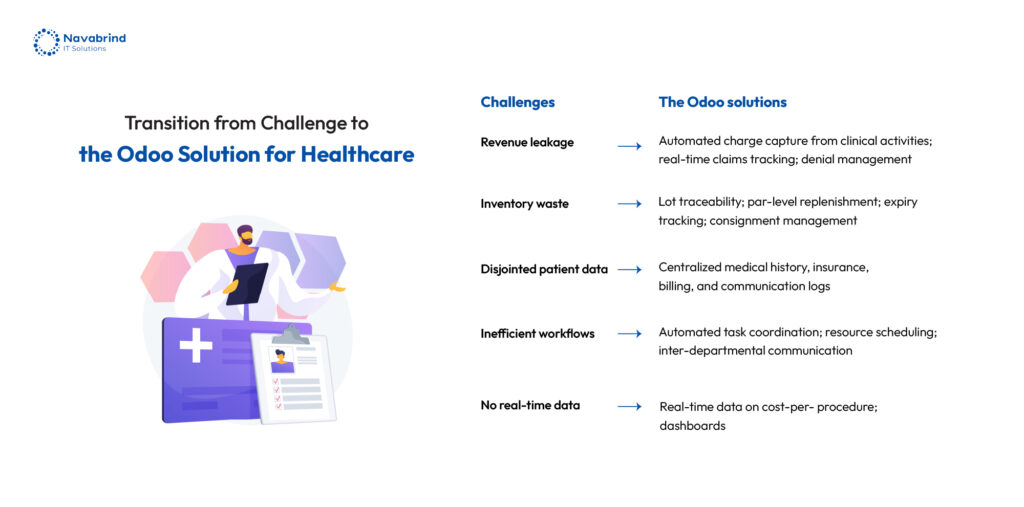
Odoo acts as the “single source of truth” for healthcare ERP system operations. Unlike standalone solutions, Odoo’s native patient management system integrates with the rest of the ERP. Hospital management system components share a common database, eliminating data silos that plague fragmented environments. From the moment a patient is referred, Odoo creates a comprehensive profile, medical history, insurance verification, billing status, and communication logs all in one place.
The integrated calendar allows front-desk staff to book appointments, verify insurance coverage, and send automated reminders, drastically reducing no-shows. Healthcare workflow management improves as scheduling connects to hospital billing software and clinical documentation. Integration with kiosks or tablets pulls data directly from the system, making check-in paperless and efficient. This is how hospital administration software begins delivering value from the first point of contact.
By unifying patient data, Odoo enables the medical inventory management system to update when procedures consume supplies. Hospital billing software captures charges without manual entry.
Challenge #2: Revenue Leakage and Complex Billing Cycles
Denied claims, delayed reimbursements, and difficulty tracking payments across Medicare, Medicaid, and private payers plague healthcare finance teams. The core issue is simple, billing is disconnected from clinical care delivery. A service is performed, but the bill never generates correctly. Hospital billing software operating in isolation misses charges because no one tells it what happened. Healthcare ERP system integration solves this by connecting clinical documentation to revenue cycle workflows. When a patient management system records a procedure, hospital billing software captures the charge. Healthcare workflow management ensures nothing falls through the cracks. Hospital management systems with unified billing eliminate manual charge capture, which causes revenue leakage. The result is faster claims, fewer denials, and predictable cash flow that supports operations rather than stressing them.

The Odoo Solution: Intelligent Hospital Billing Software
Odoo ERP elevates hospital billing software from an invoicing tool to a revenue cycle management engine. Healthcare ERP system integration means billing connects to clinical workflows. When a doctor orders a lab test or performs a procedure, the charge links to the patient’s account. Healthcare workflow management ensures billable events never get lost in the shuffle between departments.
The system tracks the lifecycle of an insurance claim, from submission to adjudication. It flags denials in real time, allowing the billing team to correct and resubmit immediately rather than weeks later. Hospital administration software with integrated claims management accelerates revenue cycles. Patient management system data flows to hospital billing software, eliminating manual charge capture.
CFOs get real-time dashboards showing accounts receivable aging, payer mix analysis, and profitability per service line. Medical inventory management system costs integrate with billing data. Hospital management systems with unified financials provide visibility that disconnected tools cannot match. Odoo transforms billing from a reactive, back-office task into a proactive, data-driven revenue generator. This financial intelligence is a benefit of healthcare ERP system implementation.
Challenge #3: Inefficient Healthcare Workflow Management
Doctors are waiting for beds. Nurses unable to locate portable equipment. Lab results delayed in reaching the right provider. These symptoms all trace to one core issue: poor healthcare workflow management creates operational bottlenecks that impact patient length of stay and satisfaction. When the patient management system data doesn’t communicate with the bed management, admissions stall. When the medical inventory management system operates in isolation, equipment vanishes. Hospital administration software that should coordinate resources instead adds layers of manual coordination. Healthcare ERP system fragmentation means departments work around each other rather than together. The result is that clinicians spend precious time hunting for what they need instead of delivering care, and patients experience the frustration of waiting while systems fail to align. This isn’t just inefficient, it’s unsustainable.

The Odoo Solution: Healthcare Workflow Management
How ERP helps healthcare organizations manage operations is by providing a central nervous system that coordinates every department. Healthcare ERP system integration means the medical inventory management system data connects to scheduling. Odoo manages the allocation of expensive, limited resources such as MRI machines and operating rooms, ensuring that a room is booked only when the required staff and equipment are available. Hospital management system visibility eliminates double-booking and idle resources.
Simple but critical tasks are automated, notifying housekeeping that a room is ready for cleaning, alerting the pharmacy when a new prescription is written. Healthcare workflow management removes manual delays that accumulate across departments. Hospital administration software that automates routine coordination lets staff focus on exceptions rather than constant status checks. Instead of phone calls and pages, Odoo centralizes communication. A lab technician marks a test as complete, which notifies the attending physician via the system.
Effective healthcare workflow management isn’t just about speed, it’s about predictability and coordination. Patient management system data flows to hospital billing software. Hospital management systems with unified workflows ensure the right hand knows what the left hand is doing, every time. This orchestration transforms reactive operations into coordinated care delivery where every department works from the same real-time information. Odoo delivers this integration natively, without the middleware patches that other systems call integration.
Challenge #4: The Black Hole of Medical Inventory Management
Frequent stock-outs of critical medications. Expired supplies are being thrown away. Inability to track high-value implants from the receiving dock to the patient. These are symptoms of a medical inventory management system operating in the dark. Inventory is managed in silos, with a central supply separate from floor stock, with manual counts and reorder processes prone to human error. Healthcare ERP system fragmentation means nobody sees the complete picture. When the patient management system schedules procedures, nobody knows if the required implants are available. Hospital management systems without integrated inventory leave clinicians guessing. Hospital administration software that doesn’t track usage cannot trigger replenishment. The result is either stockouts that delay care or excess stock that expires on shelves.
The Odoo Solution: Medical Inventory Management System
An effective medical inventory management system must track value and location. Odoo’s inventory capabilities are best-in-class. For regulatory compliance and patient safety, Odoo tracks every item by lot and serial number. If a batch of IV bags is recalled, the system identifies which patients received them. Healthcare ERP systems with complete traceability transform recall responses from chaotic to controlled.
Odoo excels at managing consignment inventory, vendor-owned supplies until use, and par-level replenishment. When the stock of a critical item falls below the threshold, a purchase order is generated. Hospital management system integration ensures floor stock never runs dry. The system prioritizes items nearing their expiration dates, reducing waste. Hospital administration software that automates replenishment eliminates the manual counts that consume staff time.
In a hospital, inventory management is a patient safety issue. Healthcare workflow management ensures that patient management system data triggers supply chain activity. When a procedure is scheduled, the required supplies are reserved. Hospital billing software captures costs at the time of use. The medical inventory management system, integrated with clinical workflows, provides visibility to ensure the right supplies are available at the right time, without waste. This precision transforms inventory from an operational headache to a strategic advantage.
Challenge #5: High Administrative Costs and Lack of Real-Time Data
Managers spend hours compiling reports from different systems. The board receives financial data that is already a month old. Without an integrated platform, generating a holistic view of the organization is a manual, time-consuming process. Healthcare ERP system fragmentation leads to leadership making decisions based on outdated information. Hospital administration software that doesn’t share data creates reporting burdens that consume administrative capacity. Patient management system data sits separate from hospital billing software, which sits separate from medical inventory management systems. Healthcare workflow management becomes spreadsheet management. The cost of this fragmentation is measured in hours, errors, and missed opportunities. A hospital management system with a unified data model eliminates manual data compilation. Real-time visibility becomes reality rather than aspiration. Administrative resources shift from chasing data to acting on insights. This transformation drives efficiency and strategic advantage.

The Odoo Solution: Real-Time Analytics and Cost Control
The ultimate benefits of the healthcare ERP system lie in its ability to provide a single source of truth that drives strategic decisions. Because Odoo is a single system, creating a report that shows relationships between staffing costs, supply usage, and revenue takes minutes, not days. A hospital management system with unified data eliminates manual compilation, saving administrative hours. Healthcare workflow management data flows into analytics without manual extraction.
Leaders can drill down to understand the cost of a knee replacement or MRI, factoring in labor, supplies, and overhead. Medical inventory management system costs are integrated with hospital billing software revenue. Patient management system volume data combines with resource utilization. This visibility is essential for negotiating value-based care contracts where understanding true cost determines success. Hospital administration software that reveals profitability per service line enables strategic decisions.
As healthcare organizations grow by acquiring new clinics, Odoo’s nature makes onboarding easy without replacing the core technology stack. A healthcare ERP system that scales with you prevents the costly migrations that plague legacy solutions. The best healthcare ERP system provides actionable intelligence, not just historical data. Odoo empowers administrators to move from “What happened?” to “What will happen?” Predictive analytics transform reactive management into strategic planning.
Building the Hospital of the Future with Odoo
The challenges facing healthcare administrators are complex, but the solution is simple: integration. By replacing a tangle of disconnected software with a unified healthcare ERP system, organizations eliminate administrative waste, improve cash flow, and, importantly, free clinicians to focus on patients. Healthcare workflow management that coordinates every department replaces the manual handoffs that slow care delivery. A hospital management system with unified data ensures that decisions are based on real-time information, not month-old reports.
Odoo is not just hospital administration software; it is a strategic platform for transformation. Whether you are a small clinic seeking a patient management system or a large hospital network struggling with medical inventory management, Odoo provides the cost-effective foundation to solve today’s challenges and scale for tomorrow’s opportunities. Hospital billing software integrated with clinical workflows accelerates revenue cycles. A healthcare ERP system that grows with you prevents the costly migrations that plague legacy solutions. The hospital of the future runs on integrated data, not fragmented systems. Odoo delivers that future today.
Implementing a healthcare ERP system requires more than technical expertise, it demands understanding how hospitals operate. Navabrind IT Solutions brings both. As certified Odoo Gold partners with healthcare domain experience, we’ve helped hospitals across the US replace fragmented systems with unified hospital management systems. Our approach combines technical implementation with operational understanding that comes from healthcare-specific experience.
We don’t just install hospital administration software. We map your clinical workflows, configure patient management systems and hospital billing software to match your requirements, and ensure your team adopts the system successfully. Healthcare workflow management expertise means we optimize processes, not just software. Medical inventory management system implementation ensures your supply chain integrates smoothly with clinical operations.
Ready to transform disconnected operations into coordinated care delivery? Navabrind IT Solutions specializes in healthcare ERP system implementations that deliver measurable results, faster billing, better supply chain visibility, and reduced administrative burden. Contact us to discuss your facility’s needs. Let’s build the foundation that lets your clinicians focus on patients while your operations run smoothly. Hospital management system implementation done right.
Frequently Asked Questions
1. How does an ERP help healthcare organizations manage operations?
The Healthcare ERP system coordinates all departments through a unified data model. The patient management system interfaces with hospital billing software, capturing charges for clinical activities. Medical inventory management system updates when supplies are consumed, triggering replenishment before stockouts. Healthcare workflow management automates routine coordination, notifying housekeeping when rooms are ready, alerting pharmacies when prescriptions are written. The hospital management system gives leadership real-time visibility across financial, clinical, and operational performance. Instead of manual reconciliations between disconnected systems, ERP eliminates silos and streamlines operations.
2. What are the benefits of ERP software for the healthcare industry?
Healthcare ERP systems deliver benefits across every level. C-Suite gains real-time financial visibility and cost-per-procedure analytics for value-based care. Clinical staff spend less time on administrative tasks through automation of healthcare workflows. Hospital billing software integrated with clinical documentation accelerates claims and reduces denials. The medical inventory management system prevents stockouts while minimizing waste. The patient management system creates smooth experiences with smoother check-in and accurate billing. The hospital management system unifies operations, delivering 30% faster processing and a 50% reduction in administrative overhead.
3. How does an ERP improve hospital management?
ERP improves hospital management systems by replacing fragmented tools with unified operations. Patient management system data flows to hospital billing software, eliminating manual charge capture. The medical inventory management system integrates with clinical schedules, ensuring supplies are available when needed. Healthcare workflow management automates inter-departmental communication, labs notify physicians, and housekeeping receives room status updates. Hospital administration software provides real-time dashboards showing bed availability, staff schedules, and financial performance. Leadership makes decisions based on current data, not month-old reports.
4. How do ERP solutions for patient and hospital management improve healthcare operations?
ERP solutions improve healthcare operations by connecting clinical and administrative data into one system. Patient management system registration populates hospital billing software. The medical inventory management system deducts supplies when procedures are documented. Healthcare workflow management coordinates resource scheduling, operating rooms book only when staff and equipment are available. The hospital management system provides real-time visibility into patient flow, bed occupancy, and staff allocation. Hospital billing software with integrated claims management reduces denial rates.
5. How do I identify the best ERP system for healthcare organizations?
Identify the best healthcare ERP system by evaluating integration, compliance, and flexibility. The system must connect the patient management system, hospital billing software, and medical inventory management system natively, not through middleware patches. HIPAA compliance requires role-based access, audit trails, and data encryption built in. Hospital management systems should support cloud, on-premise, or hybrid deployment to match your infrastructure. Look for architecture that lets you start with core functions and add modules as needs grow. Partner selection matters, choose certified implementers with healthcare domain experience. The best system delivers real-time visibility, automates workflows, and scales with your organization.
written by

Venkadesh Nagarajan
Venkatesh Nagarajan is the Founder and Chief Technology Officer at Navabrind IT Solutions, where he oversees digitalization, solution design, and automation for hundreds of customers. He is responsible for implementing the company’s full portfolio of solutions on platforms such as Odoo, Magento, Akeneo, and OdooPIM. As a techno‑functional consultant, he excels at understanding clients’ business needs and designing tailored solutions that deliver significant business value. He ensures that every client engagement is executed using industry best practices, with a focus on personalization, innovation, and adherence to budget and timelines. Venkatesh leads a team of highly skilled solution architects, developers, and project managers who are engaged in implementing, integrating, customizing, maintaining, and supporting clients across industries, including e‑commerce, retail, automotive, electronics, manufacturing, engineering, healthcare, IT and BPM, real estate, and textiles.
How can we help you?
Get in touch with a solutions consultant that can share best practices and help solve specific challenges.