Why Odoo ERP in 2026?
European manufacturers are replacing disconnected spreadsheets and outdated ERP platforms with Odoo to gain tighter control over operations, production, inventory, procurement, finance, and multi-warehouse coordination. Rising operational pressure, supply chain disruptions, and increasing compliance demands are pushing companies to rethink how data moves across departments.
For an ERP for furniture company operations, Odoo delivers stronger visibility into raw materials, custom orders, production planning, vendor coordination, and delivery cycles. In the packaging sector, ERP software for packaging industry requirements supports batch tracking, procurement flow, quality monitoring, and manufacturing control without expensive licensing layers.
This shift has placed Odoo ERP implementation Europe projects at the center of digital transformation plans for mid-sized businesses in 2026. Decision-makers are now evaluating Odoo implementation cost, deployment timelines, customization scope, and Odoo ERP pricing per user 2026 before selecting an Odoo partner Europe companies can trust for long-term operational growth, process alignment, and measurable business returns.
Understanding Odoo ERP and Its Editions
Odoo ERP connects sales, purchasing, manufacturing, inventory, accounting, CRM, HR, ecommerce, warehouse management, and reporting within one business platform. Companies across Europe are adopting Odoo ERP implementation Europe projects to replace disconnected software environments that create delays, duplicate entries, and operational confusion.
For an ERP for a furniture company environment, Odoo supports production planning, BOM management, custom product configurations, stock movement tracking, and supplier coordination. In manufacturing operations using ERP software for packaging industry workflows, teams gain stronger control over procurement, batch management, logistics, costing, and quality processes.
Odoo offers two editions: Community and Enterprise. Community works well for small businesses with limited operational requirements. Enterprise is preferred by growing European SMEs managing multi-location operations, manufacturing workflows, financial reporting, customer management, and automation requirements. Enterprise access includes enterprise applications, long-term upgrades, mobile accessibility, and enterprise support. These factors significantly influence Odoo implementation cost, deployment planning, and Odoo ERP pricing per user 2026 calculations when selecting an experienced Odoo partner Europe businesses can rely on.
Key Factors That Drive Odoo Implementation Cost
Odoo implementation cost depends on operational scale, user access requirements, process complexity, and deployment scope. One of the largest pricing factors is user count. Companies evaluating Odoo ERP pricing per user 2026 must calculate role-based access across sales teams, warehouse operators, finance departments, procurement managers, production planners, and executives. Enterprise licensing expands as business functions grow.
Module selection creates another major pricing layer. Businesses implementing sales, inventory, accounting, purchasing, MRP, CRM, ecommerce, and warehouse management require broader configuration work compared to smaller deployments. An ERP for furniture company operations may require product variants, production routing, BOM management, and multi-location inventory control. ERP software for packaging industry workflows may involve batch tracking, procurement cycles, quality checks, and manufacturing coordination across facilities in different countries.
Customization, third-party integrations, historical data migration, employee onboarding, and user training significantly shape Odoo ERP implementation Europe project budgets. Experienced Odoo partner Europe providers evaluate these operational requirements before defining timelines, licensing structure, and deployment investment.
Odoo ERP Pricing per User in 2026
Odoo Enterprise follows a subscription model based on user access and application usage. Businesses implementing Odoo ERP implementation Europe projects typically pay per user, with pricing influenced by deployment type, country, contract duration, hosting selection, and customization requirements.
In 2026, Odoo ERP pricing per user 2026 estimates across Europe range between €25 and €60 per user each month for Enterprise environments. Smaller deployments with standard configurations remain at the lower range, whereas manufacturing companies using custom workflows, API integrations, or Odoo.sh infrastructure move toward higher pricing bands.
User count significantly impacts total Odoo implementation cost. An ERP for furniture company operations may require access for procurement, production, warehouse, finance, and sales teams. ERP software for packaging industry operations may involve plant supervisors, logistics managers, quality teams, and multi-site inventory users.
Experienced Odoo partner Europe providers reduce upfront investment by phasing user onboarding. Companies frequently begin with finance, inventory, procurement, and manufacturing teams before expanding access across additional departments after stabilization and operational adoption.
Odoo Implementation Cost Ranges in Europe
Odoo implementation cost in Europe varies based on operational size, customization depth, compliance requirements, and deployment complexity. Small businesses with limited modules and standard workflows may invest between €5,000 and €20,000. Mid-sized companies implementing manufacturing, accounting, procurement, inventory, CRM, and multi-warehouse operations frequently invest between €25,000 and €120,000. Larger Odoo ERP implementation Europe projects involving multiple countries, production plants, integrations, and custom workflows can exceed €250,000.
An ERP for a furniture company environment may require configuration for product variants, production routing, warehouse planning, and supplier management. ERP software for packaging industry operations may involve manufacturing coordination, barcode systems, quality control, procurement automation, and compliance reporting.
Project budgets are typically divided into business analysis, solution architecture, module configuration, customization, third-party integrations, historical data migration, testing, and employee training. European implementation pricing remains higher than global averages due to localization demands, VAT structures, labor regulations, GDPR expectations, and country-level accounting requirements managed by experienced Odoo partner Europe providers.
Odoo ERP Implementation in Europe: What’s Different?
Odoo ERP implementation Europe projects involve operational and regulatory requirements that extend far beyond standard ERP deployment. European businesses manage VAT structures, intra-community transactions, multilingual communication, country-level accounting frameworks, electronic invoicing rules, GDPR expectations, and cross-border procurement processes. These operational layers significantly influence Odoo implementation cost, deployment planning, and long-term ERP performance.
For an ERP for furniture company environments operating across European markets, Odoo must support multiple warehouses, currency management, localized invoicing, supplier coordination, and country-based taxation. ERP software for packaging industry operations may require traceability records, manufacturing compliance workflows, barcode systems, logistics coordination, and multilingual documentation across facilities in different regions.
An experienced Odoo partner Europe businesses trust can configure localization packages, accounting structures, tax mapping, reporting standards, and workflow alignment according to regional requirements. Skilled implementation teams reduce deployment delays, compliance risks, reporting inaccuracies, and operational disruption. This expertise becomes increasingly valuable when evaluating Odoo ERP pricing per user 2026 alongside customization, integrations, and long-term scalability planning.
Industry Focus: ERP for Furniture Companies
Furniture manufacturers and distributors manage operational challenges that standard ERP setups rarely address. Make-to-order production, layered BOMs, configurable products, multiple material combinations, long procurement cycles, and fluctuating delivery timelines create operational pressure across sales, manufacturing, warehousing, and procurement teams. An ERP for furniture company environment must handle product variations across dimensions, finishes, colors, fabrics, hardware selections, and custom customer requirements without creating data chaos.
Odoo addresses these requirements through MRP, inventory, sales, purchase, product configurator, accounting, project management, and field service applications. Businesses can manage production planning, component tracking, procurement flow, warehouse visibility, quotations, delivery scheduling, installation activities, and customer order management from one connected environment. Showroom sales channels and ecommerce platforms can be linked into the operational ecosystem during Odoo ERP implementation Europe projects.
These operational requirements influence Odoo implementation cost. Variant configuration, BOM mapping, manufacturing routing, supplier workflows, online integrations, and custom reporting demand broader setup, testing, and process alignment from an experienced Odoo partner Europe provider. Odoo ERP pricing per user 2026 calculations must account for cross-functional access across production, sales, procurement, warehouse, and finance teams.
Industry Focus: ERP Software for Packaging Industry
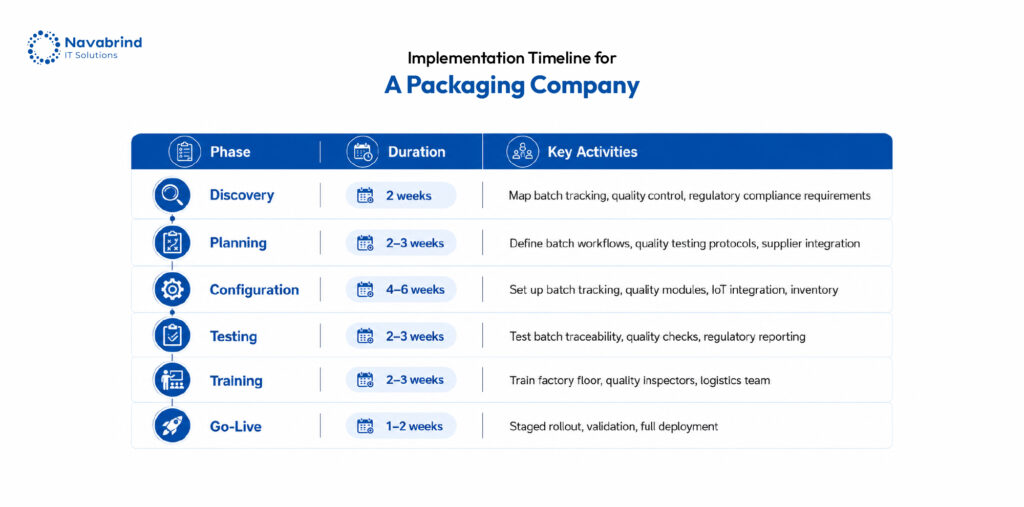
Packaging manufacturers operate within production environments driven by volume, traceability, quality standards, material control, and compliance pressure. Managing batch tracking, machine utilization, waste reduction, procurement coordination, production scheduling, and delivery timelines through disconnected software creates operational bottlenecks and reporting gaps. ERP software for packaging industry operations must support production visibility from raw material intake through dispatch and compliance documentation.
Odoo supports these manufacturing requirements through MRP, Quality, PLM, Inventory, Barcode, Maintenance, Purchase, Accounting, and reporting applications. Businesses can monitor batch movement, machine downtime, quality checkpoints, production efficiency, maintenance cycles, warehouse operations, and procurement activities from one operational platform. Odoo ERP implementation Europe projects for packaging companies frequently include barcode workflows, traceability reporting, compliance records, and plant-level production monitoring.
These manufacturing requirements significantly influence Odoo implementation cost. Quality workflows, labeling formats, custom dashboards, compliance reporting, machine integrations, MES connectivity, and production analytics require additional configuration and development effort from an experienced Odoo partner Europe provider. Odoo ERP pricing per user 2026 calculations must include production operators, warehouse staff, procurement teams, quality managers, and plant supervisors across multiple operational facilities.
Choosing the Right Odoo Partner in Europe
Selecting the right Odoo partner Europe businesses can rely on has a major impact on deployment quality, operational adoption, project timelines, and long-term ERP value. Companies should evaluate implementation certifications, manufacturing expertise, regional experience, customer references, localization knowledge, and proven delivery across furniture, packaging, retail, and distribution operations. An ERP for furniture company deployment requires understanding of configurable products, production routing, warehouse coordination, and showroom integration. ERP software for packaging industry operations demands expertise in traceability, manufacturing workflows, quality management, and compliance reporting.
Partner pricing structures significantly affect Odoo implementation cost. Daily consulting rates vary across European countries based on technical expertise, localization capability, customization depth, and support availability. Delivery methodology influences budget control as well. Agile implementations support phased deployment and operational adjustments, whereas waterfall models depend heavily on fixed-stage execution.
Businesses should avoid vague all-inclusive quotations without detailed scope mapping. Experienced Odoo ERP implementation Europe providers present phased roadmaps covering discovery, configuration, development, integrations, testing, training, and post-launch support. This structure creates stronger visibility into Odoo ERP pricing per user 2026 planning, operational priorities, and deployment investment.
How to Estimate Your Own Odoo Implementation Budget
Accurate budgeting begins with operational mapping. Companies planning Odoo ERP implementation Europe projects should first document sales flow, procurement activities, manufacturing stages, warehouse operations, accounting requirements, and reporting expectations. After identifying operational processes, businesses should prioritize modules such as inventory, MRP, accounting, CRM, purchase, ecommerce, or quality management based on immediate business requirements.
User count plays a major role in Odoo ERP pricing per user 2026 calculations. Businesses should define which employees require operational access during phase one and which departments can join later. This phased approach helps control Odoo implementation cost without delaying operational transformation.
An ERP for furniture company deployment may prioritize product configurator, BOM management, warehouse visibility, and sales workflows before adding ecommerce or field service. ERP software for packaging industry operations may begin with manufacturing, quality, inventory, and traceability before expanding into machine integrations or production analytics.
Businesses should request a structured proposal from an experienced Odoo partner Europe provider with transparent licensing, implementation services, customization scope, integrations, training, and support breakdowns instead of broad lump-sum estimates.
Ways to Reduce Odoo ERP Costs Without Compromising Quality
Businesses can reduce Odoo implementation cost by focusing on operational priorities instead of requesting extensive customization during the initial deployment stage. Standard Odoo applications already support manufacturing, inventory, procurement, accounting, CRM, warehouse management, and reporting workflows used across European companies. During Odoo ERP implementation Europe projects, companies that align processes with standard functionality achieve faster deployment timelines and lower development expenses.
Phased implementation creates stronger financial control. An ERP for furniture company deployment can begin with sales, inventory, procurement, MRP, and accounting before expanding into ecommerce, field service, or advanced reporting. ERP software for packaging industry operations may prioritize manufacturing, quality management, traceability, barcode workflows, and warehouse coordination before introducing machine integrations or production analytics. This phased structure improves operational adoption and accelerates ROI generation.
Training investment significantly reduces long-term support dependency. Businesses that assign internal key users across finance, procurement, warehouse, production, and sales departments create stronger operational continuity after go-live. Experienced Odoo partner Europe providers frequently recommend this approach when optimizing Odoo ERP pricing per user 2026 and long-term support planning.
Odoo implementation cost across Europe depends on four major factors: user count, operational scope, customization requirements, and the experience level of the implementation partner. Businesses evaluating Odoo ERP pricing per user 2026 must account for manufacturing workflows, warehouse operations, accounting requirements, integrations, compliance expectations, and long-term scalability before defining project budgets.
For an ERP for a furniture company environment, pricing is influenced by product variants, BOM structures, production planning, showroom operations, and ecommerce connectivity. ERP software for packaging industry deployments requires investment across manufacturing coordination, traceability, quality management, barcode workflows, and compliance reporting. These operational requirements make partner selection a critical business decision during Odoo ERP implementation Europe projects.
An experienced Odoo partner Europe companies trust can deliver structured deployment planning, operational alignment, localization expertise, and controlled implementation timelines without unnecessary development overhead.
Schedule a consultation or request a tailored cost assessment to receive a detailed breakdown of licensing, implementation services, deployment phases, and estimated ROI for your 2026 Odoo ERP investment.
Frequently Asked Questions
1.How much does it cost to implement Odoo ERP in Europe in 2026?
Odoo implementation cost in Europe can range from €5,000 for smaller deployments to well above €250,000 for multi-country manufacturing operations with customization, integrations, and compliance requirements. Odoo ERP implementation Europe pricing depends on user count, modules selected, localization requirements, workflow complexity, and implementation scope. Businesses evaluating Odoo ERP pricing per user 2026 should include licensing, customization, integrations, training, support, and migration expenses in their budgeting process.
2.How long does Odoo ERP implementation take for a retail business?
Retail-focused Odoo ERP implementation Europe projects generally take between 2 and 9 months depending on warehouse count, ecommerce integrations, POS requirements, accounting localization, and operational complexity. Timelines increase when businesses require custom reporting, marketplace integrations, or multi-country operations.
3.What is the total cost of Odoo ERP for a 50-user furniture company?
An ERP for furniture company deployment with 50 users may range between €40,000 and €180,000 depending on manufacturing workflows, product configurator setup, BOM complexity, warehouse operations, ecommerce integration, and customization requirements. Odoo ERP pricing per user 2026 calculations significantly influence long-term subscription investment.
4.Which Odoo modules does a packaging company need in Europe?
ERP software for packaging industry operations commonly includes Manufacturing, Inventory, Quality, PLM, Maintenance, Barcode, Purchase, Accounting, Sales, and Reporting applications. Businesses managing traceability and compliance across European facilities may require additional localization, workflow automation, and reporting configuration during Odoo ERP implementation Europe projects.
5.Is Odoo better than SAP for furniture businesses in Europe?
Odoo is frequently preferred by mid-sized furniture businesses seeking lower implementation complexity, flexible customization, faster deployment cycles, and lower operational overhead compared to SAP environments. An experienced Odoo partner Europe provider can configure furniture manufacturing workflows without the extensive infrastructure investment associated with traditional enterprise ERP platforms.
6.Does Odoo ERP support multi-currency and VAT for European retail businesses?
Yes. Odoo supports multi-currency transactions, VAT handling, localized accounting, multi-company structures, and European tax requirements. These capabilities make Odoo ERP implementation Europe projects suitable for retailers operating across multiple countries, warehouses, currencies, and supplier networks.
Schedule a conversation with us now!
Related Articles








 Post
Post Post
Post