Managing property portfolios has evolved into a high-stakes operational challenge. From handling tenant relationships to tracking financial performance and overseeing multiple assets, real estate businesses face constant pressure to stay organized, responsive, and profitable. This is where real estate ERP software and real estate management software step in as a game-changing foundation. Instead of juggling disconnected systems, businesses gain a connected environment that aligns operations, finance, and customer engagement into one streamlined workflow. The result is stronger control, faster execution, and measurable business growth.
The Growing Complexity of Managing Modern Property Portfolios
Real estate businesses are no longer dealing with a handful of properties or simple transactions. Expanding portfolios, diverse asset classes, and rising customer expectations have introduced layers of operational difficulty.
Property managers must coordinate leasing, maintenance, financial tracking, and client communication across multiple locations. Without a connected system, delays, data inconsistencies, and missed opportunities become unavoidable.With cloud-based real estate management software, teams gain centralized access to property data, tenant records, and financial insights from anywhere. This enables faster decision-making, tighter control over operations, and improved visibility across residential and commercial real estate management software use cases.
Why Spreadsheets and Siloed Tools Are No Longer Enough
Spreadsheets and disconnected applications may work in the early stages, but they quickly become a bottleneck as operations scale. Data duplication, version confusion, and lack of coordination lead to errors that impact revenue and client satisfaction.
Without integrated systems, teams struggle to align sales, leasing, and finance. This disconnect limits the effectiveness of real estate CRM software and weakens financial oversight handled through real estate accounting software. By adopting real estate ERP software, businesses eliminate fragmentation and introduce property management automation across critical workflows. From lead tracking to rent collection and financial reporting, each function operates in sync by reducing errors, saving time, and strengthening operational discipline.
What This Guide Covers: ERP, CRM, Accounting, and Automation for Real Estate
This guide breaks down how a connected ecosystem built on real estate ERP software transforms day-to-day operations. You’ll explore how real estate management software simplifies property oversight, how real estate CRM software enhances client engagement and sales tracking, and how real estate accounting software ensures financial accuracy and compliance. In addition, we’ll highlight how property management automation removes repetitive tasks, improves response times, and unlocks productivity across teams. Whether managing residential units or scaling commercial real estate management software capabilities, this approach delivers clarity, control, and sustained profitability.
What Is Real Estate Property Management ERP, and How Does It Work?
Definition of ERP in the Context of Real Estate:
Real estate ERP software serves as the operational backbone for property businesses, connecting people, processes, and data across the organization. Within real estate, this system goes beyond standard enterprise tools by aligning property operations, tenant interactions, and financial tracking into one connected framework. Unlike fragmented solutions, real estate management software built on an ERP foundation enables complete visibility across assets, transactions, and performance metrics by allowing leaders to act with confidence and speed.
How Real Estate ERP Software Connects Operations Across Departments
Disconnected teams create delays, miscommunication, and revenue leakage. Real estate ERP software eliminates these gaps by bringing finance, leasing, maintenance, and sales into one synchronized environment.
- Finance teams manage budgets, rent collection, and expense tracking through real estate accounting software
- Leasing teams handle inquiries, contracts, and renewals through real estate CRM software
- Maintenance teams track service requests and vendor coordination through property management automation
- Sales teams monitor deal pipelines, client interactions, and closures in a shared system
This connected approach ensures that updates in one department reflect across the organization instantly, improving coordination and operational control.
Key Components of Real Estate ERP Systems
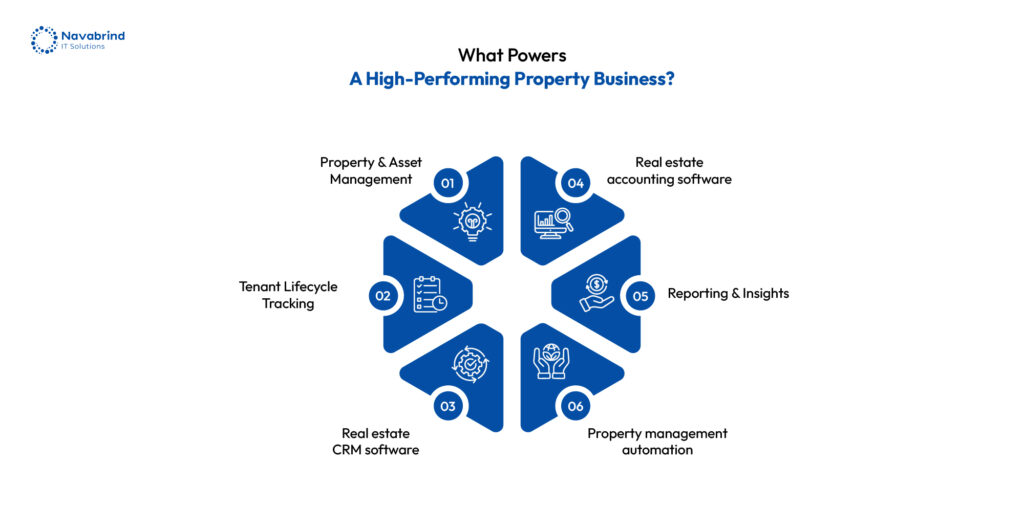
A well-implemented cloud-based real estate management software includes critical components that support day-to-day operations and long-term growth:
- Property Data Management
Centralized records for properties, units, amenities, and ownership structures across residential and commercial real estate management software environments
- Tenant Management
Complete visibility into tenant profiles, lease agreements, payment history, and communication logs via real estate CRM software
- Financial Management
Accurate tracking of income, expenses, tax calculations, and reporting through real estate accounting software
- Reporting and Insights
Actionable dashboards that highlight occupancy rates, revenue trends, and operational performance
How Data Flows Between Modules in Real Time
In traditional setups, data remains locked within separate tools. With real estate ERP software, information flows continuously across functions:
- A new lease updates tenant records and financial projections
- Rent payments reflect in accounting without re-entry
- Maintenance requests link to tenant profiles and property records
- Sales conversions update revenue forecasts and client histories
This level of property management automation reduces duplication, minimizes errors, and strengthens data reliability across the business.
Difference Between Generic ERP and Real Estate Management Software
Generic ERP systems support broad business functions but lack the depth required for property operations. They require heavy customization and still fail to address real estate workflows effectively.
In contrast, real estate management software designed for the property sector includes ready-to-use capabilities for leasing, tenant lifecycle management, and asset tracking. When combined with real estate ERP software, businesses gain a tailored solution that supports residential portfolios and commercial real estate management software needs without operational friction. For organizations aiming to scale, switching from a generic system to a cloud-based real estate management software approach backed by ERP is not an upgrade, it’s a shift toward stronger control, faster execution, and consistent revenue performance.
How Can ERP Software Benefit Real Estate Companies?
- Eliminating Data Silos Across Teams and Properties
Disconnected systems slow down operations and create blind spots across portfolios. Real estate ERP software replaces scattered tools with a connected environment where leasing, finance, sales, and operations work from shared data. With real estate management software, property details, tenant records, and financial data stay aligned across locations. Teams no longer depend on fragmented updates or duplicated entries. This clarity strengthens coordination across residential assets and commercial real estate management software operations.
- Reducing Errors in Lease Tracking, Invoicing, and Compliance
Errors in lease terms, billing cycles, or regulatory filings can lead to revenue loss and compliance risks. Real estate ERP software addresses this by introducing consistency across workflows. Through real estate accounting software, rent calculations, invoicing, and financial records stay aligned with lease agreements. Property management automation ensures that renewals, reminders, and compliance checkpoints are tracked without gaps by minimizing risk and improving accuracy.
- Faster Decision-Making Through Centralized Dashboards and Reporting
Growth depends on timely, data-backed decisions. Without a connected system, extracting insights becomes time-consuming and unreliable. Cloud-based real estate management software provides centralized dashboards that present occupancy trends, revenue performance, and tenant activity in one place. Leaders gain instant visibility into portfolio health, enabling quicker responses to market changes and operational needs.
- Scalability for Growing Portfolios: Residential, Commercial, and Mixed-Use
As portfolios expand, operational complexity increases. Managing multiple asset types through disconnected tools creates inefficiencies that limit growth. Real estate ERP software supports expansion by standardizing processes across residential units, office spaces, and mixed-use developments. Whether scaling leasing operations or managing high-value assets through commercial real estate management software, the system adapts without operational disruption.
- Cost Savings Through Property Management Automation
Operational costs rise when repetitive tasks consume time and resources. Property management automation reduces dependency on repetitive processes across leasing, billing, and maintenance tracking. By integrating workflows within real estate management software, businesses cut down administrative overhead, reduce rework, and improve team productivity. These efficiencies translate into measurable cost savings and stronger margins.
- Improved Tenant and Client Experience
Tenant satisfaction plays a direct role in retention and revenue stability. Delayed responses, billing errors, or poor communication can impact long-term relationships. With real estate CRM software integrated into real estate ERP software, teams gain a complete view of tenant interactions, preferences, and service history. Faster responses, accurate billing through real estate accounting software, and consistent communication elevate the overall experience. This approach not only strengthens tenant retention but also enhances brand reputation by creating a competitive edge in both residential and commercial real estate management software markets.
What Features Should Property Management Accounting Software Have?
- Automated Rent Collection and Invoicing
Consistent cash flow depends on accurate billing and timely collections. Real estate accounting software within real estate ERP software enables automated rent schedules, recurring invoices, and payment tracking without gaps.
With property management automation, rent reminders, late fee calculations, and payment confirmations are handled without delays by ensuring steady revenue cycles and improved financial discipline across portfolios.
- General Ledger, Accounts Payable, and Accounts Receivable Tailored to Real Estate
Generic accounting tools fail to address the complexity of property transactions. Real estate accounting software aligned with real estate management software brings property-level accounting into focus.
- General ledger mapped to properties and units
- Accounts payable linked to vendors, maintenance, and utilities
- Accounts receivable tied to tenants, leases, and billing cycles
This structure ensures financial clarity across residential assets and commercial real estate management software environments.
- Lease Accounting Compliance (ASC 842 / IFRS 16)
Regulatory compliance demands accurate lease classification and reporting. Real estate ERP software supports ASC 842 and IFRS 16 requirements by aligning lease data with financial records. Automated calculations for lease liabilities, right-of-use assets, and amortization schedules reduce compliance risks and simplify audit readiness without relying on disconnected spreadsheets.
- CAM (Common Area Maintenance) Reconciliation for Commercial Properties
Managing shared expenses across tenants can impact profitability if not tracked correctly. Commercial real estate management software within an ERP framework enables accurate CAM reconciliation. Expenses related to maintenance, utilities, and shared services are allocated based on lease terms. This ensures transparent billing, reduces disputes, and protects revenue across commercial properties.
- Multi-Entity and Multi-Currency Support
Expanding portfolios across regions introduces financial complexity. Cloud-based real estate management software supports multi-entity structures and multi-currency transactions within a single system. Businesses can manage subsidiaries, joint ventures, and cross-border operations without losing financial control by ensuring consistent reporting and compliance across regions.
- Financial Reporting: P&L by Property, Cash Flow Statements, Tax Preparation
Strong financial oversight requires detailed, property-level insights. Real estate accounting software integrated with real estate ERP software delivers reporting that goes beyond standard summaries.
- Profit and loss statements by property or unit
- Cash flow visibility across portfolios
- Tax-ready financial data aligned with regulatory requirements
These insights support informed decisions and strengthen long-term profitability.
- Integration with Real Estate CRM Software and Transaction Tools
Financial data gains full value when connected with sales and tenant interactions. Integration between real estate CRM software and real estate accounting software ensures that deals, leases, and payments stay aligned. From lead conversion to lease execution and revenue recognition, property management automation connects the entire lifecycle. This alignment eliminates data gaps, improves accuracy, and strengthens operational control across real estate management software ecosystems.
How Does Real Estate CRM Software Fit Into the ERP Ecosystem?
- Managing Leads, Prospects, and Client Relationships Alongside Operations
Growth in real estate depends on how well teams manage relationships across the lifecycle from first inquiry to long-term tenancy. Real estate CRM software plays a central role within real estate ERP software by connecting client interactions with operational data. With real estate management software, sales, leasing, and operations teams access shared information on prospects, tenants, and property availability. This alignment ensures that conversations, property details, and transaction updates stay consistent across departments.
- Tracking Buyer and Tenant Pipelines in One Place
Disconnected tracking leads to missed opportunities and poor visibility into deal progress. Real estate CRM software brings buyer and tenant pipelines into a single system, aligned with real estate ERP software workflows. Teams can monitor inquiry status, property visits, negotiations, and closures without switching tools. Whether handling residential sales or managing leasing pipelines through commercial real estate management software, this visibility strengthens conversion rates and pipeline control.
- Automating Follow-Ups, Communications, and Document Sharing
Delayed responses reduce engagement and impact deal outcomes. Property management automation within real estate CRM software ensures consistent communication across the client journey.
- Follow-ups triggered based on inquiry stage
- Email and message tracking linked to client profiles
- Document sharing for agreements, brochures, and contracts
This approach keeps prospects engaged, shortens deal cycles, and improves coordination across teams using cloud-based real estate management software.
- How CRM Data Feeds Into Deal Flow and Financial Forecasting
Sales and leasing data hold significant value beyond client management. When connected to real estate ERP software, CRM insights contribute to accurate revenue planning and forecasting.
- Deal stages influence projected income
- Lease closures update financial records within real estate accounting software
- Pipeline trends highlight demand across properties
This connection ensures that business leaders can align sales performance with financial outcomes, strengthening planning and portfolio management.
- CRM vs. ERP: Understanding the Distinction and Why You Need Both
Real estate CRM software and real estate ERP software serve distinct roles, yet deliver maximum impact when used together.
- CRM focuses on managing relationships, tracking leads, and driving conversions
- ERP manages operations, financials, and property performance through real estate management software
Relying on one without the other creates gaps. CRM without ERP limits operational visibility, and ERP without CRM restricts growth potential. By combining both within a cloud-based real estate management software environment, businesses gain full control over client relationships, financial performance, and operational execution creating a strong foundation for sustained revenue growth.
How Does Real Estate Transaction Management Software Simplify Property Deals?
- Centralizing Contracts, Documents, and E-Signatures
Property deals involve multiple documents, approvals, and stakeholders. Managing these across emails and disconnected tools leads to delays and version confusion. Within real estate ERP software, transaction management capabilities bring contracts, agreements, and e-signatures into one controlled environment. Integrated with real estate management software, teams can access the latest documents, track changes, and secure approvals without chasing paperwork. This centralized approach strengthens control over deal documentation across residential and commercial real estate management software operations.
- Automating Deal Milestones and Deadline Tracking
Missed deadlines can delay closures and impact revenue timelines. Property management automation within transaction workflows ensures that critical milestones are tracked with accuracy. From offer acceptance to final registration, each stage is mapped and monitored within cloud-based real estate management software. Alerts and task triggers keep brokers, managers, and legal teams aligned, ensuring deals progress without bottlenecks.
- Visibility Across All Active Transactions for Brokers and Managers
Limited visibility across deals creates uncertainty and slows decision-making. Real estate ERP software provides a unified view of all active transactions, enabling teams to monitor progress, identify delays, and take action. With real estate CRM software connected to transaction workflows, brokers can track client interactions alongside deal status. Managers gain portfolio-level visibility, ensuring that no opportunity is overlooked.
- Reducing Deal Cycle Time with Workflow Automation
Lengthy deal cycles reduce throughput and tie up resources. By embedding property management automation into transaction processes, businesses can accelerate deal execution.
Task assignments, document approvals, and communication flows move forward without dependency on repetitive coordination. This allows teams to close deals faster and handle higher transaction volumes using real estate management software.
- Integration with Accounting Software for Invoices and Commission Payouts
Closing a deal is only part of the process by which financial execution must follow without delays. Integration between transaction workflows and real estate accounting software ensures that financial actions are triggered as soon as deals are completed.
- Invoice generation linked to deal closure
- Commission calculations aligned with contract terms
- Payment tracking connected to financial records
This connection within real estate ERP software eliminates gaps between sales and finance, ensuring accurate payouts and revenue recognition across the business.
Commercial Real Estate Management Software — Unique Needs and Considerations
How Commercial Portfolios Differ from Residential
Commercial assets introduce a different level of operational and financial complexity compared to residential properties. Lease structures include variable rent terms, escalation clauses, and shared cost allocations such as CAM charges. Tenant profiles vary across retail, office, and industrial spaces, each with distinct expectations and contract terms. Commercial real estate management software within real estate ERP software addresses these complexities by aligning lease data, tenant obligations, and financial tracking in one system. This ensures accurate billing, stronger control over lease terms, and improved coordination across mixed tenant portfolios.
Features Tailored for Commercial Real Estate Management Software
Managing commercial properties requires capabilities that go beyond standard property tools. Real estate management software designed for commercial use includes:
- Space Planning
Visual tracking of occupied and vacant units, enabling better utilization and leasing decisions
- Tenant Improvement Tracking
Monitoring fit-out costs, approvals, and timelines tied to lease agreements
- Lease Abstracting
Capturing critical lease terms such as rent schedules, escalation clauses, renewal dates, and obligations in a structured format
These capabilities, supported by property management automation, reduce administrative burden and ensure that complex lease conditions are executed accurately.
Managing Large Multi-Site Portfolios from a Single Platform
Commercial portfolios frequently span multiple cities, regions, or countries. Managing such scale through disconnected systems leads to inconsistencies and limited oversight. Cloud-based real estate management software enables centralized control across locations, allowing teams to manage assets, tenants, and financials from one platform. Integrated within real estate ERP software, this approach ensures consistent processes, standardized reporting, and stronger operational alignment across all sites.
Reporting for Investors, Asset Managers, and Stakeholders
Stakeholders in commercial real estate expect detailed insights into asset performance and financial returns. Generic reporting fails to capture the depth required for informed decisions.
Real estate accounting software combined with commercial real estate management software delivers:
- Property-level profit and loss analysis
- Revenue breakdowns by tenant and lease type
- Expense tracking, including CAM allocations
- Portfolio performance insights for investor reporting
With data flowing across real estate CRM software, leasing, and finance, stakeholders gain a complete view of asset performance by supporting confident investment decisions and long-term portfolio growth.
Cloud-Based Real Estate Management Software: Why It Matters
- Accessibility Across Offices, Field Teams, and Remote Staff
Real estate operations extend beyond office desks that is through site visits, client meetings, and on-ground coordination demand constant access to information. Cloud-based real estate management software ensures that teams can view property data, tenant details, and deal status from any location. Integrated with real estate ERP software, this access connects leasing teams, finance professionals, and managers without delays. Field teams update information on the go, and leadership tracks performance without waiting for reports by creating a responsive, well-coordinated operation.
- Automatic Updates and Reduced IT Overhead Compared to On-Premise Systems
Maintaining on-premise systems requires ongoing investment in infrastructure, maintenance, and upgrades. Cloud-based real estate management software removes this burden by delivering continuous system enhancements without operational disruption. With real estate ERP software, businesses stay aligned with evolving compliance requirements, financial standards, and operational needs without managing servers or upgrade cycles. This reduces IT costs and frees up resources for revenue-focused activities.
- Data Security, Backups, and Disaster Recovery
Data loss or security breaches can disrupt operations and damage credibility. Cloud-based real estate management software provides secure data storage, regular backups, and recovery mechanisms that protect critical business information. From tenant records managed through real estate CRM software to financial data handled by real estate accounting software, sensitive information remains protected. This ensures business continuity and safeguards operational integrity even during unexpected disruptions.
- Integration with Third-Party Tools
Real estate businesses rely on multiple tools for payments, communication, and specialized workflows. Cloud-based real estate management software supports integration with external platforms, ensuring smooth data exchange across systems.
- Payment gateways for rent collection and transaction processing
- Communication tools for client engagement and notifications
- External accounting platforms aligned with real estate accounting software
When connected with real estate ERP software, these integrations eliminate duplication, maintain data consistency, and strengthen overall operational flow.
- Scalability Without Infrastructure Investment
Growth in real estate brings added properties, tenants, and transactions. Traditional systems struggle to keep up without significant infrastructure expansion. Cloud-based real estate management software allows businesses to scale operations without additional hardware or complex setup. Whether expanding residential portfolios or managing large assets through commercial real estate management software, the system adapts to increasing demands. Combined with property management automation, this scalability ensures that operations remain controlled, costs stay predictable, and growth opportunities are captured without operational strain.
What Is the Best Real Estate ERP Software Solution for Property Businesses?
Choosing the right real estate ERP software is not about picking a popular platform by selecting a system that aligns with how your business operates, scales, and generates revenue. The difference between average and high-performing real estate firms comes down to how well their real estate management software supports execution, visibility, and financial control.
What to Look for When Evaluating Platforms
A high-impact real estate ERP software should deliver depth across operations, not just surface-level features.
Focus on:
- Scalability
The system must support growth across residential, rental, and commercial real estate management software portfolios without performance drop-offs
- Module Depth
Look beyond basic features that ensure strong capabilities in real estate CRM software, real estate accounting software, leasing, and property management automation
- Integration Capabilities
The platform should connect with payment gateways, communication tools, and external systems to maintain data consistency across workflows
- Vendor Support and Implementation Expertise
A strong partner ensures faster deployment, better customization, and long-term success
Platforms like Odoo-based solutions stand out because they connect property management, sales, and accounting within one ecosystem, improving visibility and operational control
Factors That Vary by Business Size
The definition of the “right” solution changes based on your scale and portfolio type:
- Small Agencies
Need lightweight real estate management software with strong real estate CRM software capabilities to manage leads, listings, and deals
- Mid-Sized Firms
Require balanced functionality across CRM, leasing, and real estate accounting software, along with reporting for performance tracking
- Large Commercial Operators
Demand advanced commercial real estate management software features such as lease abstraction, CAM reconciliation, and multi-entity financial control
ERP platforms that adapt across these stages provide long-term value without forcing system changes during growth.
Build vs. Buy Considerations
Building a custom system may seem attractive for control, but it comes with high cost, long timelines, and ongoing maintenance challenges.
Buying an established real estate ERP software solution offers:
- Proven workflows for property, tenant, and financial management
- Faster implementation timelines
- Continuous updates and improvements
- Lower risk compared to custom development
In most cases, configuring a flexible ERP platform delivers stronger ROI than developing a system from scratch, especially when standard processes like accounting and invoicing are already well-defined.
Learn more : Key considerations before implementing Odoo for real estate
How to Assess ROI on Real Estate Business Management Software
ROI should be measured beyond software cost. The real value of real estate ERP software comes from operational impact:
- Revenue Growth
Improved deal tracking through real estate CRM software increases conversion rates
- Cost Reduction
Property management automation reduces administrative overhead and rework
- Faster Closures
Integrated workflows shorten deal cycles and improve cash flow
- Financial Accuracy
Real estate accounting software ensures accurate reporting, reducing compliance risks
- Portfolio Visibility
Centralized dashboards provide insights across properties, tenants, and financials, enabling better decisions
ERP systems for real estate centralize data across development, sales, tenant management, and finance, allowing businesses to manage operations and improve performance from a single platform A strong cloud-based real estate management software backed by ERP is not just a technology upgrade, it becomes the foundation for predictable growth, tighter financial control, and a scalable real estate business model.
Frequently Asked Questions
1. What Is the Best Real Estate ERP Software Solution for Property Businesses?
The ideal real estate ERP software is one that aligns with your business model, portfolio size, and operational complexity. A strong solution combines real estate management software, real estate CRM software, and real estate accounting software into a connected environment. Look for platforms that support property management automation, multi-property tracking, and financial control across residential and commercial real estate management software needs. The right choice delivers scalability, integration capabilities, and visibility across operations by ensuring long-term growth without system limitations.
2. How Can ERP Software Benefit Real Estate Companies?
Real estate ERP software improves business performance by eliminating disconnected tools and centralizing operations.
- Removes data silos across departments
- Reduces errors through automation
- Strengthens financial visibility via real estate accounting software
- Improves decision-making with centralized reporting
- Enhances client engagement through real estate CRM software
By consolidating operations into one platform, ERP enables faster workflows, better coordination, and improved profitability.
3. What Is Real Estate Property Management ERP, and How Does It Work?
Real estate ERP software is a system that connects leasing, finance, maintenance, sales, and tenant management into one platform. Instead of using separate tools, teams operate from a shared data environment.
When a lease is signed, financial records, tenant details, and operational workflows update instantly across the system. This connected structure improves accuracy, reduces duplication, and ensures consistent data across the organization.
4. How Does Real Estate Transaction Management Software Simplify Property Deals?
Transaction management within real estate management software streamlines deal execution from start to finish.
- Centralizes contracts, documents, and approvals
- Tracks deal milestones and deadlines
- Provides visibility across active transactions
- Uses property management automation to accelerate deal progression
By connecting with real estate ERP software and real estate accounting software, deal closures trigger invoicing and commission workflows with faster revenue realization and financial accuracy.
5. What Features Should Property Management Accounting Software Have?
A strong real estate accounting software solution should support:
- Automated rent collection and invoicing
- General ledger, accounts payable, and receivable tailored to properties
- Lease compliance (ASC 842 / IFRS 16)
- CAM reconciliation for commercial real estate management software
- Multi-entity and multi-currency operations
- Financial reporting such as P&L by property and cash flow tracking
When integrated into real estate ERP software, these features ensure financial transparency, compliance, and control across the portfolio.
6. How Does Real Estate Business Management Software Improve Operations?
Real estate management software improves operations by connecting data, workflows, and teams into one system.
- Centralized data ensures consistent information across departments
- Property management automation reduces repetitive tasks and manual effort
- Integrated real estate CRM software improves lead tracking and client communication
- Financial insights from real estate accounting software support better planning
This connected approach increases productivity, reduces operational friction, and enables scalable growth across residential and commercial real estate management software portfolios.
Schedule a conversation with us now!
Related Articles









 Post
Post Post
Post