




How Odoo ERP Helps Hospitals Manage Patient Records Securely
- March 23, 2026
- Posted by: Lillian D Costa
- Categories: Blog, Odoo ERP for hospital patient records
Why Odoo is Disrupting Healthcare ERP
Healthcare organizations face a difficult choice. Legacy ERP systems cost millions and resist change, while best-of-breed solutions create data silos that fragment patient information across disconnected departments. Odoo Healthcare ERP offers a third path. Its open-source model delivers enterprise capabilities without enterprise price tags. Modular architecture means you implement what you need today and add more later, no forced upgrades, no costly customizations.
Odoo isn’t just another ERP, it’s an integrated ecosystem where clinical and administrative modules share the same database. Patient records connect to billing. Supply inventory links to procedure scheduling. Compliance documentation ties to every relevant transaction. This real-time visibility across the healthcare enterprise eliminates the manual reconciliations that consume staff time and introduce errors.
This blog post explores how Odoo Healthcare ERP functions as a complete hospital management system. We’ll address the regulatory, operational, and financial challenges of the US healthcare landscape, HIPAA compliance, value-based care reporting, supply chain complexity, revenue cycle management. Through design, customization capabilities, and cost-effective deployment, Odoo ERP for the US Healthcare Industry delivers what legacy systems promised but never achieved, unified operations without compromise.
What Makes Odoo Different for Healthcare? The Architectural Advantage
- The Open-Source Foundation: Unlike proprietary healthcare ERP solutions, Odoo’s open architecture allows unprecedented customization without vendor lock-in. Odoo Healthcare ERP lets you modify source code to match your workflows rather than forcing your clinical and administrative teams to adapt to rigid software. This flexibility is essential when dealing with unique protocols, reporting requirements, and operational nuances across different healthcare settings.
- True Integration vs. “Integration” Claims: Many vendors claim integration but deliver middleware patches that merely pass messages between disparate systems. Odoo hospital management system modules, from patient management to accounting, share the same technical foundation and database. This native integration ensures data consistency without the complexity of HL7/FHIR-based connections that break or require constant maintenance. Patient information flows seamlessly from registration through billing without manual reconciliations.
- Modularity with Purpose: Healthcare organizations can start with core modules like patient registration and appointment scheduling, then gradually add functionality as needs grow. Odoo ERP for the US Healthcare Industry supports this “crawl-walk-run” approach, reducing implementation risk and upfront investment. You’re not forced to deploy everything at once. Add laboratory management, inpatient tracking, or revenue cycle modules when your team is ready, not when the vendor demands.

Core Components of the Odoo Hospital Management System
Patient Management Foundation:
Odoo Healthcare ERP provides comprehensive patient registration capturing demographics, emergency contacts, insurance information, and unique identifiers. Automatic sequence generation ensures consistent record-keeping across multiple facilities and prevents duplication errors. Family-linking capabilities track household health patterns and maintain emergency contact chains across related patients. This foundation ensures every clinical and administrative interaction starts with complete, accurate patient data. Registration clerks complete intake once; every department accesses the same trusted information.
Clinical Workflow Management:
Appointment Scheduling Engine: Calendar-based scheduling with status tracking, Draft, Confirmed, In Progress, Completed, Cancelled, plus duration management and provider resource allocation. The system prevents double-booking and sends automated reminders to reduce no-shows. Patients self-schedule through integrated portals, reducing administrative phone traffic. Schedulers see real-time availability across providers and locations simultaneously. The practice calendar operates from one unified view.
Medical Records Architecture: Secure storage of patient history, diagnoses, vital signs, lab results, and treatment documentation with role-based access controls ensuring HIPAA compliance. Clinicians access complete records instantly from any authorized device. Audit logs track every view and edit for security and compliance purposes. Records organize chronologically, making it easy to review patient progress over time. Critical information never gets lost in paper files or scattered across disconnected systems.
Prescription Management: Digital prescription creation with dosage tracking, medication history, and pharmacy integration for smooth fulfillment. The system checks for drug interactions automatically based on patient medication history. Providers send prescriptions electronically, eliminating paper and phone call delays. Refill requests route to the appropriate provider with complete context. Medication adherence improves through automated renewal reminders and patient portal access.
Specialty Care Modules:
Pediatric Functionality: Newborn management with APGAR scoring, neonatal reflex checks, congenital disease screening, and specialized pediatric medication tracking. Growth charts plot automatically against standardized percentiles. Vaccination schedules track and alert when immunizations are due. Developmental milestone tracking helps identify concerns early. Pediatric-specific workflows ensure nothing falls through the cracks for your youngest patients.
Department Management: Structured organization by specialty, Cardiology, Orthopedics, etc, with department head assignments and provider grouping for clear accountability. Each department maintains its own protocols, scheduling rules, and reporting preferences. Cross-department referrals flow smoothly with complete patient context. Department performance metrics roll up to enterprise dashboards automatically. Clinical and financial accountability becomes transparent at every level.
Multi-Branch Operations: Native support for managing multiple clinical locations, outpatient clinics, and specialty centers within a single Odoo hospital management system instance. Odoo ERP for the US Healthcare Industry ensures consistent operations across your enterprise. Patients can book appointments at any location with full visibility into provider availability. Inventory transfers between facilities track automatically with complete documentation. Enterprise reporting consolidates data from across all locations without manual aggregation.

Odoo for the US Healthcare Industry: Compliance and Regulatory Architecture
HIPAA Compliance Framework:
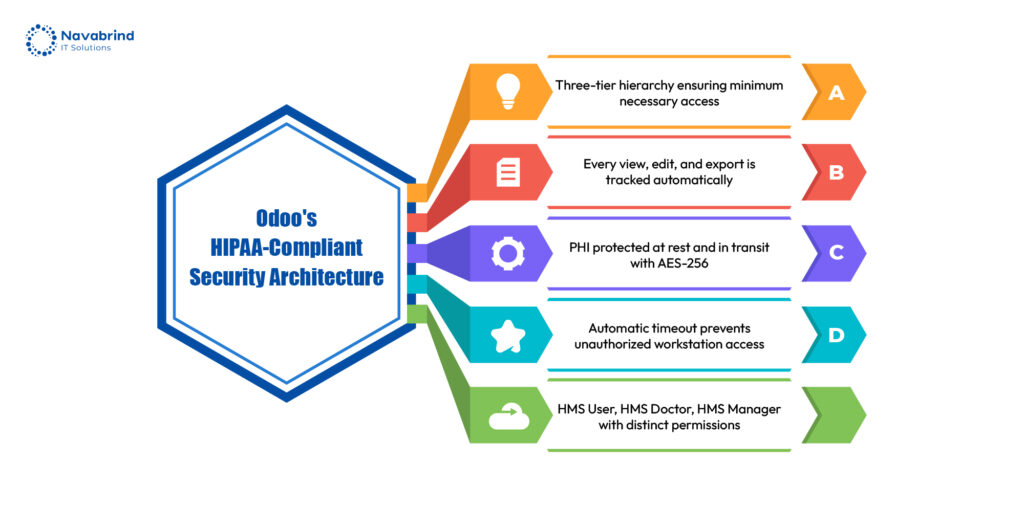
Odoo Healthcare ERP implements technical safeguards, including role-based access control, automatic session timeout, and comprehensive audit logging of data access and modifications. Every patient record view, edit, or export leaves a traceable audit trail. Data encryption protects Protected Health Information at rest and in transit, with LUKS-encrypted volume options for on-premise deployments. A three-tier access hierarchy, HMS User, HMS Doctor, HMS Manager, enforces minimum necessary access principles automatically.
FDA and Regulatory Considerations for MedTech Integration:
For organizations combining clinical care with medical device management, Odoo hospital management system supports traceability requirements for FDA-cleared devices. Enhanced features connect serial numbers to supplier certifications, repair histories, and compliance documentation. Audit-ready reporting maps to regulatory requirements without manual compilation. Device tracking becomes smooth rather than a separate compliance burden.
US Healthcare Requirements:
Odoo ERP for the US Healthcare Industry addresses multi-state compliance considerations for organizations operating across state lines. Native integration capabilities connect with US payor systems, insurance claims processing, and Medicare/Medicaid billing requirements. The system handles the complexity of American healthcare reimbursement while maintaining clinical excellence. Compliance becomes built-in rather than bolted-on.
Financial Operations: Billing, Revenue Cycle, and Insurance Management
Comprehensive Billing Engine:
Odoo Healthcare ERP delivers native invoicing for healthcare services, appointments, lab tests, procedures, prescriptions, and inpatient services. Automatic charge capture pulls from clinical activities, ensuring no revenue slips through cracks. The system supports multiple payor types, including private insurance, government programs, and self-pay patients. Billing becomes an automatic downstream result of care delivery rather than a separate administrative burden.
Insurance Claims Management:
Odoo hospital management system automates the claims workflow from provider appointment through treatment documentation to claim generation and payor submission. Automated data validation and claim scrubbing reduce billing errors before submission. Real-time claims tracking shows where each claim stands, while denial management capabilities help your team address rejections quickly. Revenue cycles accelerate when claims are processed correctly the first time.
Financial Reporting and Analytics:
Odoo ERP for the US Healthcare Industry provides real-time dashboards showing revenue by service line, payor mix analysis, and accounts receivable aging. Integrated clinical and financial data enables accurate cost-per-procedure analytics that reveal profitability. Audit-ready financial reporting satisfies compliance reviews and reimbursement audits without manual spreadsheet compilation. Leadership sees financial health and acts on insights immediately.

Operational Excellence: Inventory, Supply Chain, and Pharmacy Integration
Medical Inventory Management:
Odoo Healthcare ERP provides real-time tracking of pharmaceuticals, medical supplies, and equipment across multiple clinical locations. Automated stock alerts prevent stockouts of critical items while minimizing carrying costs through optimized reorder points. Batch and expiry date management ensures medication safety and regulatory compliance, and expiring items flag before reaching patients. Inventory counts reconcile smoothly with usage data from clinical activities.
Pharmacy Integration:
Odoo hospital management system creates connections between prescribing, dispensing, and billing workflows. Providers see real-time pharmacy stock visibility when writing prescriptions, preventing orders for unavailable medications. Dispensing triggers automatic inventory deductions and generates billing charges simultaneously. Automated replenishment based on usage patterns keeps pharmacy shelves stocked without excess. The medication lifecycle operates from one integrated system.
Procurement and Vendor Management:
Odoo ERP for the US Healthcare Industry streamlines purchase requisitions, approval workflows, and purchase order generation for medical supplies. Vendor compliance tracking ensures suppliers meet regulatory requirements before products reach your facility. Contract management optimizes purchasing across the enterprise, leveraging total volume for better pricing. Procurement becomes strategic rather than transactional when integrated with clinical demand data.
Implementation Deep Dive: Case Studies and Real-World Applications
Case Study: Multi-Specialty Hospital Transformation
A 250-bed hospital achieved 30% faster patient processing, 99% billing accuracy, and zero stockouts of critical medications through Odoo Healthcare ERP implementation. The phased migration approach ensured zero data loss and minimal operational disruption during transition. Staff adoption succeeded through intensive training and role-based system access that matched each team’s actual workflows. Clinical and administrative teams operate from unified data rather than disconnected systems.
Case Study: US Healthcare Provider Scaling Operations
A healthcare chain with day care facilities transformed from fragmented systems to a unified Odoo hospital management system, achieving 50% reduction in administrative overhead. The implementation addressed multi-state compliance requirements, provider-to-billing automation, and real-time operational visibility across expanding locations. Post-implementation results showed 40% improvement in billing accuracy and accelerated reporting cycles. Leadership sees enterprise-wide performance rather than waiting for manual consolidations.
Case Study: Home Healthcare EMR Migration
A Florida-based home healthcare facility migrated from a legacy system to Odoo, achieving 100% caregiver adoption within 30 days. Odoo ERP for the US Healthcare Industry enabled 70% reduction in payroll processing time while passing HIPAA and AHCA compliance checks with zero findings. Field caregivers document visits on mobile devices with offline capability. The unified platform eliminated duplicate data entry and manual reconciliations that previously consumed hours daily.

Technical Architecture and Customization Capabilities
Odoo’s Technical Foundation for Healthcare:
Odoo Healthcare ERP runs on a Python-based backend with PostgreSQL database ensuring data integrity and scalability for growing healthcare organizations. Model-view-controller architecture enables clean separation of data, logic, and presentation, making customization safer and more maintainable. API-first design allows smooth integration with EHR systems, lab instruments, and external healthcare networks. This foundation provides the stability healthcare operations demand with the flexibility clinical workflows require.
Extending Odoo for Healthcare:
Custom module development addresses specialized clinical workflows that off-the-shelf systems cannot accommodate. Integration with HL7/FHIR standards ensures interoperability with existing healthcare IT infrastructure, protecting prior investments. Odoo hospital management system includes mobile optimization for field clinicians who need on-the-go access to patient records and documentation tools. Extensions become parts of the platform rather than bolted-on afterthoughts.
Deployment Options:
Cloud deployment delivers scalability and reduced IT overhead for organizations focused on operational efficiency. On-premise deployment satisfies strict data sovereignty requirements for institutions with security mandates. Odoo ERP for the US Healthcare Industry supports hybrid approaches that balance accessibility with security, critical data on-premise, less sensitive functions in the cloud. Choose the model that fits your compliance needs without compromising functionality.
Advanced Capabilities and Future Directions
AI and Automation in Odoo Healthcare:
Odoo Healthcare ERP includes AI-powered chatbots handling patient intake and appointment scheduling, reducing administrative phone traffic. Predictive analytics forecast patient volumes, enabling optimal resource allocation and staffing decisions. Automated billing workflows minimize manual intervention while reducing errors and accelerating reimbursement. AI becomes a practical assistant rather than a theoretical concept.
Telemedicine Integration:
Odoo hospital management system extends to support virtual care delivery with native telemedicine capabilities. Smooth integration with leading telehealth platforms ensures smooth patient-provider encounters regardless of location. Unified documentation captures in-person and virtual visits in the same patient record, maintaining complete clinical histories. Care continuity persists whether patients visit physically or connect remotely.
Interoperability Roadmap:
Odoo ERP for the US Healthcare Industry continues evolving health information exchange capabilities through enhanced HL7/FHIR integration. Connectivity with regional health information organizations and national networks enables comprehensive patient data sharing. Support for emerging interoperability mandates ensures your organization remains compliant as requirements evolve.

Strategic Considerations for Adoption
Build vs. Buy vs. Customize:
Odoo Healthcare ERP offers evaluation criteria, use standard modules for common functions, configure for workflow alignment, custom-develop only for unique requirements. Total cost of ownership dramatically undercuts traditional healthcare ERP vendors, often by 50-70%. Certified Odoo partners with healthcare domain expertise ensure compliance knowledge matches technical capability. The right partner separates successful implementations from expensive lessons.
Change Management and Adoption:
Successful Odoo hospital management system adoption requires strategies for overcoming resistance from clinical and administrative staff. Role-based training ensures each user group understands their workflows rather than overwhelming everyone with irrelevant features. Measuring adoption metrics enables continuous improvement cycles that address friction points.
ROI Expectations and Timeline:
Healthcare implementations complete in 3-9 months, depending on scope and complexity. Documented case studies show 30% faster patient processing and 50% administrative reduction post-implementation. Odoo ERP for the US Healthcare Industry delivers break-even within 12-18 months, with long-term value compounding as additional modules deploy. The investment case strengthens with every efficiency gain and error prevented.
Build vs. Buy vs. Customize:
Odoo Healthcare ERP offers evaluation criteria, use standard modules for common functions like patient registration and billing, configure for workflow alignment through built-in settings, and custom-develop only for unique clinical requirements. Total cost of ownership undercuts traditional healthcare ERP vendors, by 50-70% over five years. Certified Odoo partners with healthcare domain expertise ensure compliance knowledge matches technical capability. The partner separates successful implementations from expensive lessons learned through trial and error.
Change Management and Adoption:
Successful Odoo hospital management system adoption requires strategies for overcoming resistance from both clinical and administrative staff who fear workflow disruption. Role-based training ensures each user group understands their specific workflows rather than overwhelming everyone with irrelevant features that create confusion. Measuring adoption metrics like login frequency and feature usage enables continuous improvement cycles that address friction points quickly. Staff become advocates when systems make their work easier rather than harder.
ROI Expectations and Timeline:
Healthcare implementations are complete in 3-9 months, depending on scope, facility count, and complexity of existing workflows. Documented case studies show 30% faster patient processing through streamlined intake and 50% administrative reduction from automated billing and documentation. Odoo ERP for the US Healthcare Industry delivers break-even within 12-18 months, with long-term value compounding as additional modules deploy across the enterprise. The investment case strengthens with every efficiency gain and billing error prevented.
Is Odoo Right for Your Healthcare Organization?
Odoo’s Value Proposition:
Odoo Healthcare ERP delivers unmatched flexibility through open-source architecture; you adapt the system to your workflows rather than forcing clinical teams to adapt to rigid software. Complete integration eliminates data silos by sharing one database across patient management, billing, inventory, and compliance. Cost-effective scaling means the platform serves small clinics and multi-state health systems without replacing software as you grow. Proven compliance capabilities meet US healthcare requirements including HIPAA, FDA traceability, and payor integrations.
Decision Framework:
Ask yourself, Are you tired of manual reconciliations between disconnected systems? Does your current vendor charge premium fees for basic customizations? Do you need visibility across clinical and financial operations in real time? Odoo hospital management system makes sense when flexibility, integration, and cost matter. It may not fit organizations invested in legacy ecosystems unwilling to migrate. Next steps, schedule a discovery call with certified healthcare ERP partners who understand Odoo’s capabilities and US healthcare requirements. Odoo ERP for the US Healthcare Industry deserves evaluation when your current system creates more friction than function.
Tailored Odoo Implementations from Navabrind IT Solutions
Navabrind IT Solutions delivers tailored Odoo implementations that address the unique operational demands of the US healthcare industry, from medical device manufacturing and pharmaceutical distribution to healthcare supply chain management. By leveraging Odoo’s modular architecture, Navabrind IT Solutions configures integrated solutions that unify inventory tracking, equipment maintenance, quality management, and regulatory compliance (including FDA traceability and HIPAA-aligned data practices) within a single platform.
Our approach streamlines procurement, ensures serial number and lot traceability for critical medical supplies, and automates maintenance schedules for life-sustaining equipment, reducing administrative overhead while improving patient care readiness.
As an Odoo Gold Partner and with over a decade of experience, Navabrind IT Solutions enables healthcare organizations across the US to replace fragmented legacy systems with a cohesive, scalable, and cost-effective ERP that supports operational efficiency and strict regulatory adherence.
Frequently Asked Questions
1. How does Odoo Healthcare ERP help hospitals manage patient records securely?
Odoo Healthcare ERP secures patient records through role-based access control ensuring only authorized personnel view sensitive information. Every access and modification leaves an audit trail for compliance monitoring. Data encryption protects Protected Health Information at rest and in transit. Automatic session timeout prevents unauthorized access from unattended workstations. Odoo hospital management system combines these safeguards with HIPAA-compliant configurations for complete data protection.
2. Can Odoo hospital management system integrate with existing hospital software in the US?
Odoo hospital management system integrates with existing software through API-first architecture and HL7/FHIR interoperability standards. Lab systems, imaging equipment, and specialty applications connect without replacing working infrastructure. The platform integrates with US payor systems, claims processors, and Medicare/Medicaid billing. Odoo Healthcare ERP serves as the unifying layer connecting fragmented systems. This approach protects prior investments while consolidating data.
3. How does Odoo ERP for the US Healthcare Industry ensure real-time access to patient data across departments?
Odoo ERP for the US Healthcare Industry ensures real-time access through unified database architecture, every module shares the same data source. When registration updates demographics, scheduling sees changes instantly. Lab results post and physicians view them immediately without delays. Clinicians access complete records from any authorized device across multiple facilities. Odoo Healthcare ERP maintains this real-time visibility whether patients visit outpatient clinics, urgent care, or the main hospital.
4. What modules does Odoo Healthcare ERP offer for managing patient billing and medical records?
Odoo Healthcare ERP offers native invoicing for appointments, procedures, lab tests, and prescriptions. Automatic charge capture pulls from clinical activities preventing revenue leakage. Insurance claims management automates treatment documentation through payor submission. Medical records modules store patient history, diagnoses, lab results, and treatment documentation. Odoo hospital management system ensures billing accuracy and clinical completeness without duplicate data entry.
5. How does Odoo hospital management system improve data security and access control?
Odoo hospital management system improves security through role-based access restricting data by job function. Automatic session timeout prevents unauthorized access from unattended workstations. Comprehensive audit logging tracks every view and edit for compliance verification. Odoo Healthcare ERP encrypts Protected Health Information at rest and in transit. Three-tier access hierarchy enforces minimum necessary access principles automatically.
6. How does Odoo ERP for the US Healthcare Industry handle electronic health records (EHR)?
Odoo ERP for the US Healthcare Industry handles EHR through secure architecture storing patient history, diagnoses, and lab results in a unified database. Role-based access controls ensure only authorized clinicians view sensitive information. Records organize chronologically for easy patient progress review. Odoo Healthcare ERP supports HL7/FHIR interoperability with existing EHR infrastructure. The system offers comprehensive EHR capabilities for organizations seeking complete replacement.
written by

Lillian D Costa
B2B Marketing Strategist and Lead
Lillian D Costa is an experienced marketing professional with a strong passion for driving brand growth and innovation. With 15 years of proven expertise, she specializes in developing and executing comprehensive marketing strategies for both emerging startups and established brands. Skilled at defining the marketing vision, she leads a team responsible for launching impactful content strategies, lead‑generation programs, and go‑to‑market initiatives for new products. Alongside the marketing team, Lillian is consistently focused on achieving sustainable business expansion and fostering a culture of innovation.
How can we help you?
Get in touch with a solutions consultant that can share best practices and help solve specific challenges.